
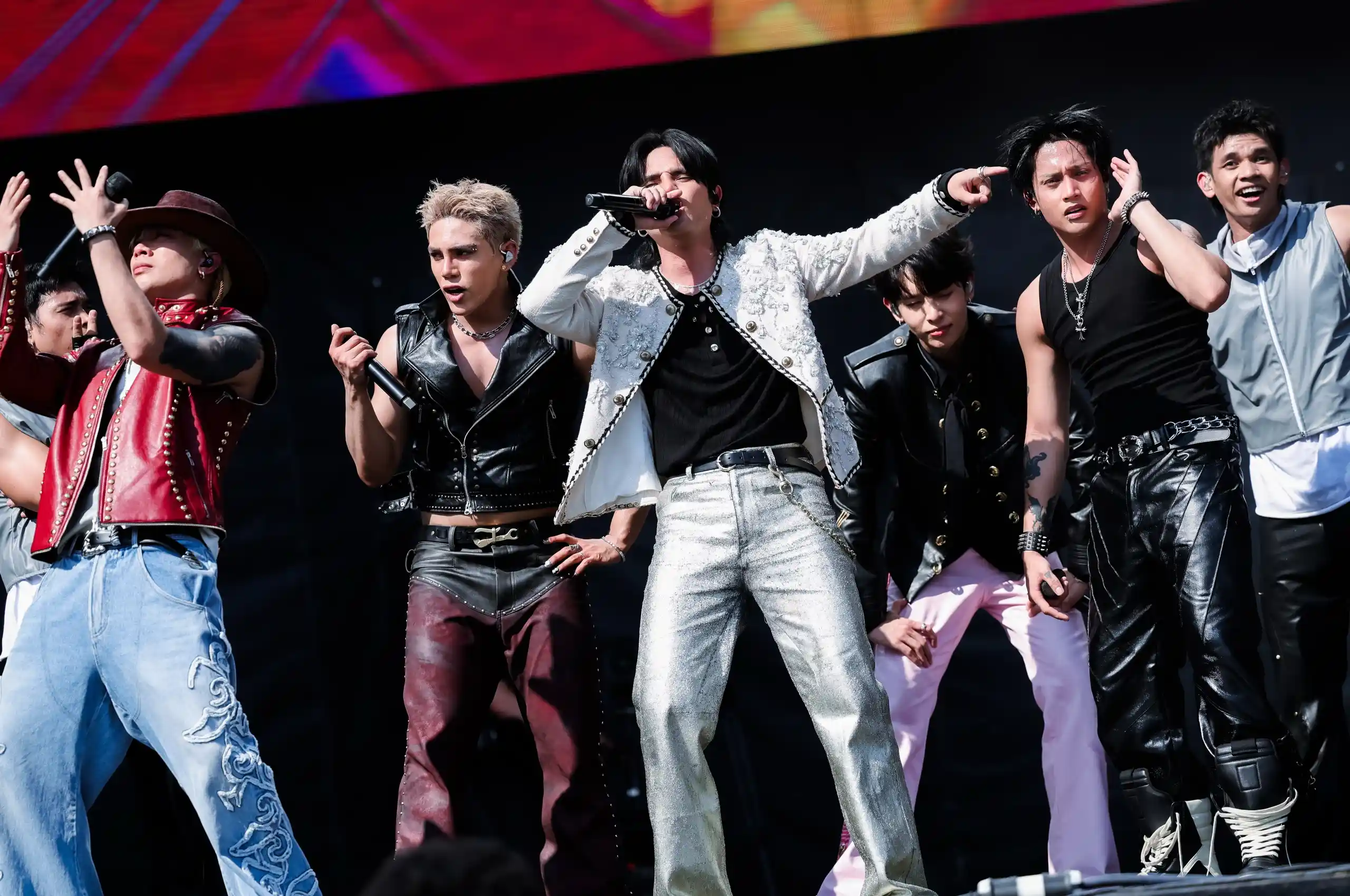
Days after SB19 took the Allianz Stage at Lollapalooza, the Philippine Senate has entered the story.
Not with another performance. With paperwork.
Senator Paolo Benigno “Bam” Aquino IV filed Senate Resolution No. 545 on July 31, one day after SB19 became the first Filipino act to perform at Lollapalooza. Senator Francis “Kiko” Pangilinan followed with Senate Resolution No. 573 on August 4. Both measures put the group’s Chicago appearance into the machinery of the Philippine government, where a festival set becomes something considerably more official: a matter for the legislative record.
SB19’s Lollapalooza performance was, first, a pop-culture event. It was a major American festival slot, a milestone for Filipino music, and another step in a global run that has increasingly made the group look less like a local success story and more like an export.
Now it is also a Senate story.
From Grant Park to the Senate Record
Aquino’s resolution recognizes SB19’s Lollapalooza appearance as a significant milestone for Filipino artists and Original Pilipino Music on the global stage. Pangilinan’s resolution similarly describes the performance as a momentous occasion that brought Filipino music, arts, and dance before an international audience.
That distinction matters.
A Senate resolution does not create an international career. It does not get an artist onto a festival lineup, sell tickets overseas, negotiate a tour, or build an audience in another country. It does something more symbolic: it tells the official record that the thing that happened mattered.
And there is something slightly strange, and revealing, about that.
The cultural sector tends to move faster than the institutions built to support it. An artist can spend years building an audience abroad, reach a stage like Lollapalooza, and only afterward become legible to the state as a national achievement.
By the time government recognition arrives, the difficult part has already happened.
The Export We Keep Celebrating After the Fact
This is where the SB19 story becomes bigger than SB19.
The Philippines has no shortage of artists capable of producing cultural moments abroad. What it has struggled to build is a reliable system for turning those moments into a sustained creative economy.
South Korea offers the obvious comparison. Its global entertainment industry did not become an export powerhouse because one government agency discovered K-pop and decided to cheer loudly. It grew through years of investment in training, infrastructure, intellectual property, distribution, and the machinery surrounding cultural production.
The Philippine model is still much more improvised.
An artist breaks through. Fans mobilize. Private companies take the risk. The audience proves there is demand. The international invitation arrives. Then, eventually, government officials show up to congratulate everyone.
There is nothing wrong with the congratulations. The question is what happens after them.
When SB19 shares a festival bill with artists such as Charli XCX and Lorde, the interesting question is not whether the Philippines should be proud. Obviously it should.
The more consequential question is whether the country sees these moments as isolated victories or evidence of an industry worth deliberately building.
What Happens After the Applause?
A Senate resolution is cheap compared with the machinery required to create a global creative industry.
In May, the Senate recognized BINI after the group became the first Filipino act to perform at the Coachella Valley Music and Arts Festival, adopting Senate Resolution No. 370 sponsored by Aquino. The group was formally honored at the Senate on May 6.

The recognition did not end there. In July, the Department of Tourism named BINI one of the country’s tourism ambassadors, turning the group’s international visibility into an actual government partnership. Later that month, SB19 was named a tourism ambassador as well. The DOT has described the initiative as a way to use globally recognized Filipino talent to promote the Philippines and its culture to audiences abroad.
That is a more tangible government response than a Senate commendation.
It is also telling that the first major institutional follow-through is happening through tourism rather than cultural policy. The government has recognized that a pop group can do more than sell records: it can move people, and potentially move money with them.
The question for SB19’s Lollapalooza recognition is whether the same logic can travel beyond tourism.
SB19 has already done its part. It crossed the ocean, walked onto the stage, and played.
Now comes the less photogenic part.
If the government wants to treat that performance as a national milestone, it also has to decide whether the milestone is the destination or the evidence of something that could happen again.
The Resolution Passed. Then Came a Bill.
On September 28, the Senate unanimously adopted Resolution No. 545. SB19 was at the session to receive a copy from Aquino and other senators, and Senator Joel Villanueva co-sponsored the measure.
The bigger news came with it. Aquino, who chairs the Senate Committee on Trade, Commerce and Entrepreneurship, said he is writing a bill on the creative economy with SB19 and its management company, 1Z Entertainment. In a livestream with the group after the session, he said members Pablo and Josh had come to him with the problems Filipino artists run into abroad, visas among them. SB19 had already put that complaint into a song: “VISA,” the lead single from its 2026 album Wakas at Simula.
The bill would create a government agency for the creative economy to support Filipino artists working overseas, and Aquino said it has the backing of the Department of Trade and Industry (DTI). His model is the Korea Creative Content Agency (KOCCA), the South Korean government institution that supports the country’s creative industries. Describing the current setup, Aquino said that “if you’re an artist and you’re gonna fly, you’re on your own.” Josh added that he hopes the Philippine Creative Industries Act, Republic Act No. 11904, which lapsed into law in July 2022, can be amended to cover creatives who travel.
The bill has no name or filing date yet, and Aquino said he would keep consulting other creatives before it goes in. ElysPlanet will follow it once it is filed.
Pingback: SB19 Just Had Its Best Week in Japan. The Country Hadn’t Even Met Them Yet. | ELYSPLANET