
THERE’S MORE TO Coca-Cola than that refreshing, ice-cold beverage enjoyed and shared with loved ones to make mealtimes special. In some of the Philippines’ remote villages where water is scarce, in communities where women are working to lift their household income, and in schools where students struggle with poor health, Coca-Cola has quietly become a sign of hope and progress.
That’s largely thanks to the various programs run through the company’s social responsibility arm, the Coca-Cola Foundation Philippines, Inc.
Since its founding in November 1986, the Foundation has helped improve the quality of life for hundreds of thousands of Filipinos through education, health, water sanitation, and livelihood programs, the Foundation said in a press statement received by ElysPlanet.Com. It has also provided emergency assistance during disasters and carried out various environmental conservation projects.
For its 30th year, the Foundation’s current programs focus on bringing safe water access to underserved rural communities and creating education and development opportunities for Filipino youth.
Diego Granizo, Coca-Cola Philippines’ President and General Manager, said, “At Coca-Cola, we have a shared vision of growing our business and enhancing the sustainability of local communities around the world. We are very thankful that for the past 30 years, we have been given wonderful opportunities to serve thousands of Filipino communities, share happiness and make a difference in the lives of countless people through programs implemented through the Foundation and our partners.”

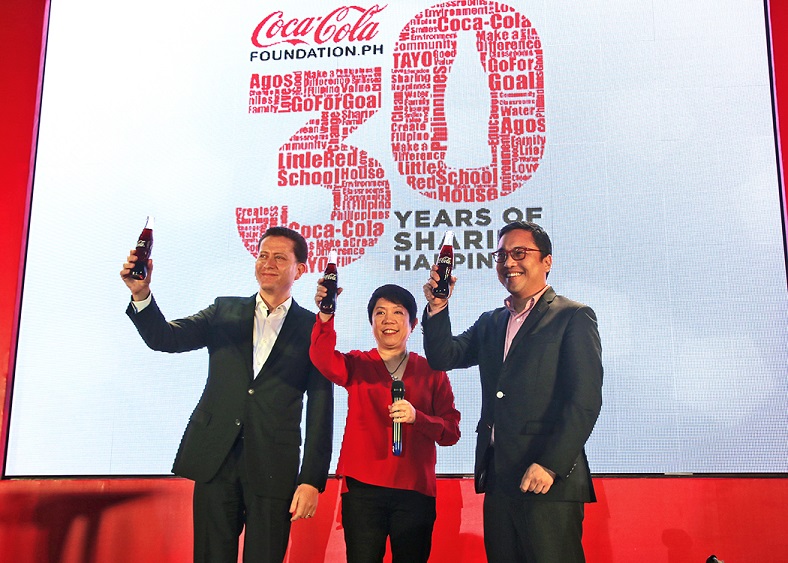
Coca-Cola Philippines Vice President for Public Affairs and Communications Atty. Adel Tamano and Coca-Cola FEMSA Philippines Director for Legal and Corporate Affairs Atty. Jorenz Tanada, lead the ribbon cutting of The Happiness Project exhibit of the Coca-Cola Foundation Philippines on its 30th anniversary.
The Happiness Project
The Foundation is highlighting its impact on Filipino communities through a soon-to-be-published 30th-anniversary magazine dubbed ‘The Happiness Project.’ The publication features stories written by the University of Sto. Tomas Journalism Society, with photos by De La Salle-College of Saint Benilde (DLSU-CSB) School of Design and Arts students and faculty volunteers. Together, they captured stories of struggle, hope, and dreams realized among the communities and program partners the Foundation works with.
The Happiness Project magazine, along with videos and photos capturing these true stories, will be on exhibit from November 10 to 12 at the Activity Area of Gateway Mall, Araneta Center, Cubao, Quezon City — a project made possible through a partnership with the J. Amado Araneta Foundation and Araneta Group.
Among the “happiness” stories: a barangay captain in Bato, Leyte, and a 74-year-old man in Baao, Camarines Sur, both finally gaining access to clean drinking water through the Foundation’s Agos project, run in partnership with the Alternative Indigenous Development Foundation, Inc. and the Philippine Rural Reconstruction Movement. The project uses gravity-fed installations to bring water from upland sources down to communities below.
The Happiness Project also features the stories of young Tacloban students rebuilding after super typhoon Yolanda and a retired high school teacher in Butong, Quezon province, both of whom rediscovered their passion for learning and teaching, respectively, through the Foundation’s Little Red Schoolhouse project. The two-story, typhoon-resilient schoolhouse inside Marasbaras Elementary School in Leyte has six classrooms, each fully equipped with chairs, tables, blackboards, and comfort rooms, while the Little Red Schoolhouse at Quezon National High School-Apyao Annex is the first one built for middle school students.
“Our work in Coca-Cola Foundation has rewarded us over a hundred-fold – with warm smiles and the sincere expressions of gratefulness from the people we have met along the way. Even a tearful speech of a grandfather who has turned hopeful that his grandchildren will have a better life because they now have free flowing fresh water a few steps from their home, beats any award or trophy,” said Cecile Alcantara, Coca-Cola Foundation Philippines President.

