
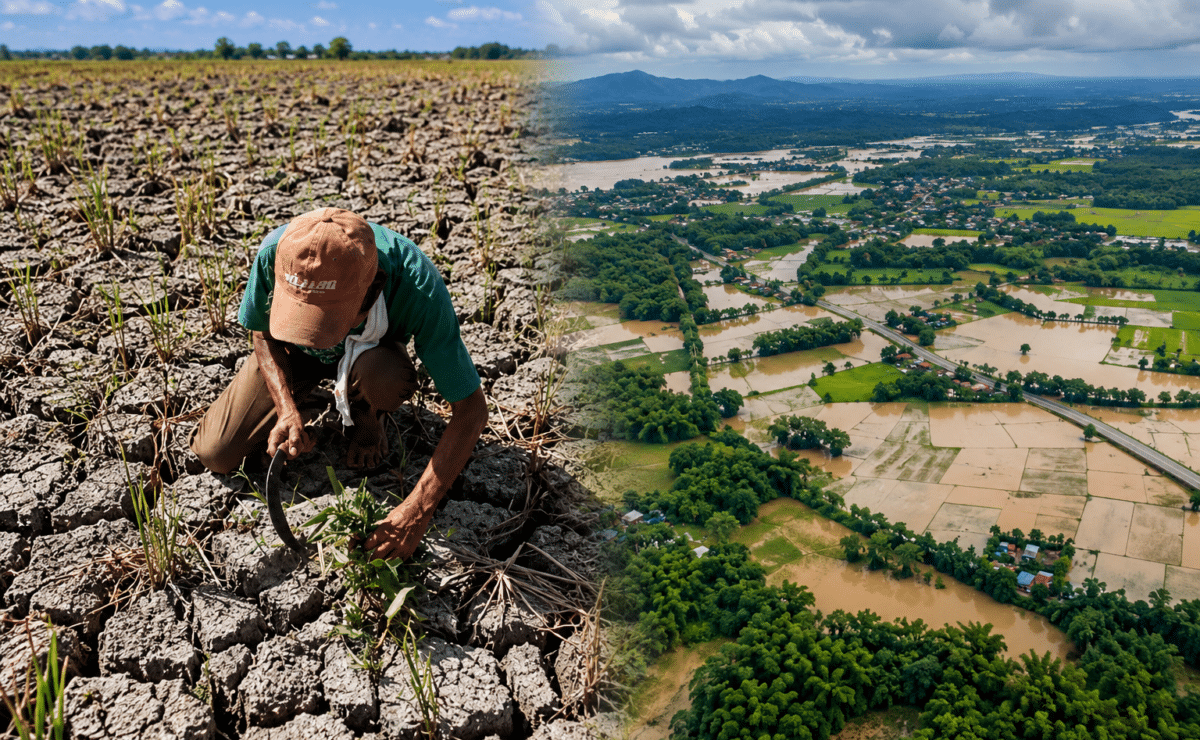
Rice is the line in the household budget that almost no one trims. When the price moves, it moves for everyone, and the families with the thinnest cushions feel it first. That is why the weather forecast now matters to the grocery list.
The Philippine Atmospheric, Geophysical and Astronomical Services Administration (PAGASA), the government weather bureau, said in late July that there is an 81 percent chance El Niño will intensify into a “very strong” event between October 2026 and January 2027. It put the chance that El Niño conditions last through the first half of 2027 at 97 percent. El Niño is a warming of the central Pacific Ocean that, in the Philippines, usually means less rain and hotter, drier weather.
On October 5, Science and Technology Secretary Renato Solidum Jr. warned that every province in the country could be under dry or drought conditions by the end of March 2027.
What Is Already Happening
Some of the damage is already on the books. The National Disaster Risk Reduction and Management Council (NDRRMC), the government body that coordinates disaster response, counted 388,375 people affected by El Niño as of early October, with 106 cities and towns under a state of calamity. The Department of Agriculture (DA) put agricultural damage at ₱6.87 billion as of late September, affecting more than 223,000 farmers and 249,028 hectares of farmland across 14 regions.
For rice, the DA expects palay (unmilled rice) output to fall by about 700,000 metric tons during the main harvest in the second half of 2026. Agriculture Secretary Francisco Tiu Laurel Jr. has said the department is better prepared than it was during the previous El Niño, while acknowledging that overall production will still be lower.
The Import Picture
Lower local output usually means more imports. In a grain report released in late September, the United States Department of Agriculture (USDA) lowered its forecast for Philippine milled rice production to 12.25 million metric tons for the July 2026 to June 2027 marketing year, down from 12.36 million, citing drier weather during the May–June planting season and high fertilizer costs. It forecast rice imports for the same period at 5.2 million metric tons.
The Philippines had already imported 3.9 million metric tons of rice as of mid-September 2026, which is more than the 3.4 million metric tons it imported across all of 2025.
What the Government Is Doing
The DA says it has expanded the active warehouses of the National Food Authority (NFA), the state agency that keeps the government’s rice buffer stock, from about 300 to 365, and is opening cold storage for meat and vegetables. It has begun cloud seeding, which uses aircraft to coax rain from existing clouds, in Isabela and Negros, and a ₱6.2 billion package covers fuel and fertilizer support for farmers, fisherfolk and agricultural transport.
What Is Forecast and What Is Certain
A forecast of lower harvests is not the same as a certain price increase. Imports, government buffer stocks and rainfall can all change the outcome. This column has no price forecast to offer, and anyone who gives you a specific peso figure for March is guessing.
What can be said is that the risk points in one direction. Rice, vegetables, eggs, meat and electricity are all items that a prolonged dry spell can push upward.
The Questions Worth Asking Your Household
A financial plan is a set of answers to “what if.” Here are four that fit this one.
How much of your monthly spending is food, and how much of that is rice and other staples? If you do not know, a single month of receipts will tell you.
If your grocery bill rose by a tenth, which category would give? Deciding that now is easier than deciding it at the checkout counter.
How many months of basic expenses are in your emergency fund? A fund exists for situations where several costs move together. Food, electricity and transport can all rise in the same stretch.
Who depends on a daily-wage or farm income in your extended family? The people closest to the harvest are the ones for whom a drought is an income problem before it is a price problem.
None of this is a prediction. It is the same discipline that makes any plan hold up when the forecast turns out right.
Pingback: What If Prices Keep Rising Faster Than Your Savings Earn? | ELYSPLANET