
There are easier ways to introduce the Philippines to a foreign audience.
You can lead with the beaches. You can lean into fiestas, hand-woven barongs, and the familiar inventory of tropical abundance and radiant Filipino hospitality, polished just enough to clear customs without raising an eyebrow.
Ea Torrado’s Brown Madonna chose something considerably less tidy.
Following its world premiere at the Sincerely Yours, the Philippines festival at Künstler*innenhaus Mousonturm in Frankfurt in September 2025, and a European run this June that included Berlin and Braunschweig, the full-length dance-theater work is finally returning home. It will be performed August 15 and 16 at Myra Beltran Dance Forum in Quezon City, as part of Daloy Dance Company’s 12th-anniversary season.
What the work brings back across borders is not a tourist souvenir.
The Altar and the Arena
At its core, Brown Madonna is about the contradictory jobs Filipino women are expected to perform: mother, martyr, entertainer, saint. Torrado gets there through Catholic iconography, pop culture, labor, sexuality, class, family memory and the particular Filipino talent for putting the sacred and the ridiculous within arm’s reach of each other.
The central collision is built into the title.
Madonna the pop star. Madonna the Virgin Mary.
Torrado shares a birthday with the American pop icon, but the resemblance goes further: both came through dance, both grew up Catholic, and both have spent their careers negotiating questions of self-determination and reinvention. The difference is that Madonna got to turn reinvention into an empire. Torrado has had to make art while carrying the less glamorous weight of keeping an independent dance company alive.
That tension gives Brown Madonna its peculiar charge.
The piece began taking shape in 2018 as a dance-theater work influenced by Madonna. Seven years later, it had become something much more autobiographical, drawing on Torrado’s mother and grandmother, Marian devotion, work, family obligation and the contradictions surrounding the Filipina body.
And then there are the costumes.
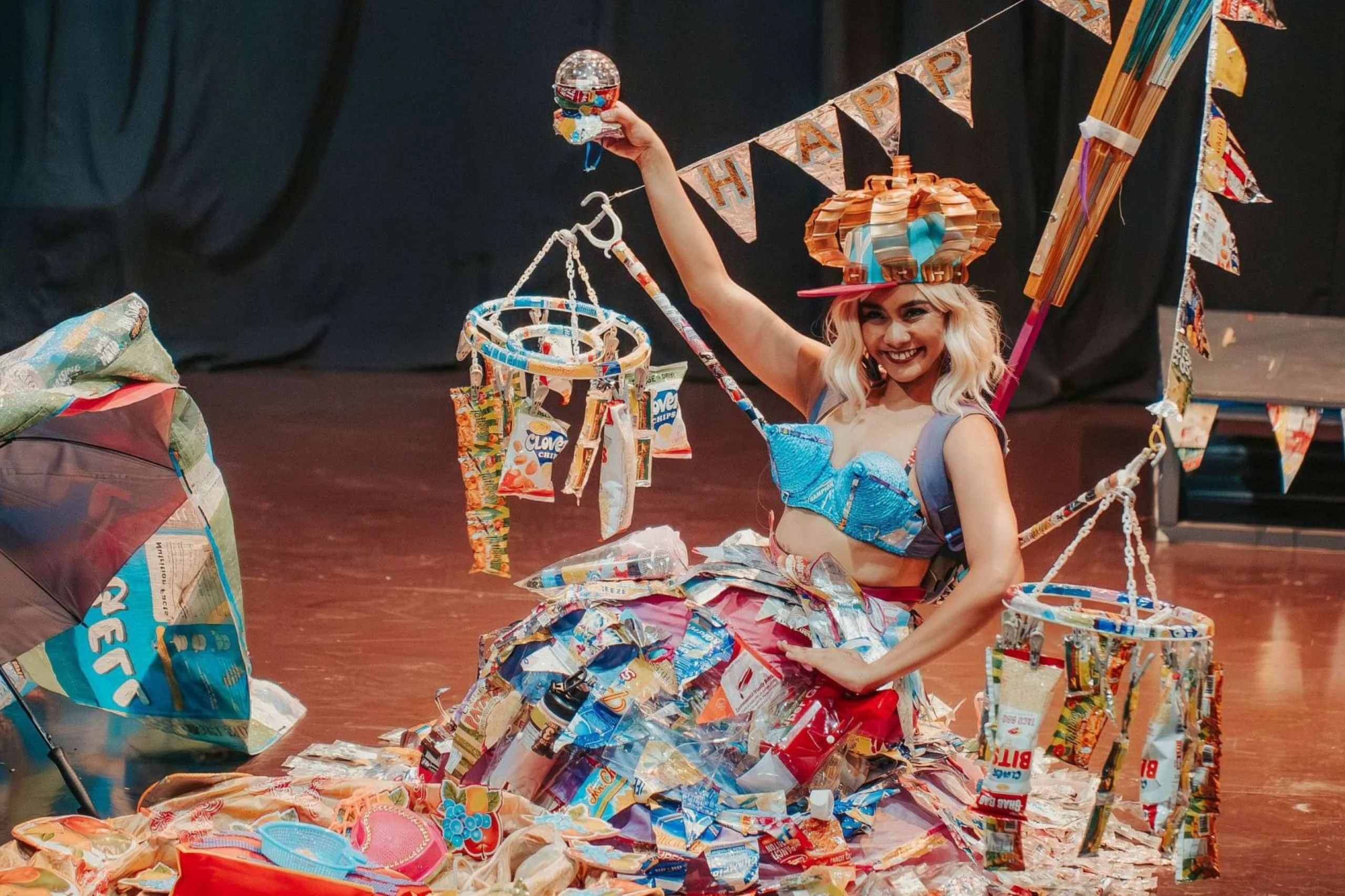
Leeroy New, with collaboration from Arvie Santos, turns Filipino everyday life into stage material. Sachet packaging, plastic wrappers, fiesta bunting and commercial rice sacks become part of Torrado’s changing silhouette. At one point she disappears beneath a fabric made from rice sacks; later, the sacks return as a veil for a giant Mama Mary figure, complete with an oversized heart and Santo Niño.
It is hard to imagine a more Filipino material vocabulary.
The sari-sari store meets the altar.
The Angel rice sack becomes religious vestment.
The cheap plastic thing you would normally ignore becomes the thing you are supposed to look at.
Then the image gets less saintly.
Torrado appears in a bikini and a pointed bra recalling Madonna’s Jean Paul Gaultier cone bustier. She twerks. She sings. She bends backward. She plays with the audience. At another point, the performance turns toward rap, eventually landing on colonization.
The joke is not really that Mama Mary can rap.
The joke is that perhaps she should have been allowed to all along.
Torrado has described wanting the Marian figure to have a voice: a woman who can be loving and motherly but also angry, raunchy and loud. The saint is no longer required to remain still.
The Economics of Survival
There is a less glamorous story underneath all that spectacle.
Torrado founded Daloy Dance Company in 2014. The realities of sustaining an independent contemporary dance company in the Philippines are not separate from Brown Madonna; they are part of its material.
Torrado has spoken about the decision to incorporate singing and theater partly as a joke, after years of fundraising and trying to sustain Daloy. But there is an obvious practical calculation underneath the joke: musicals and hybrid theatrical productions tend to command broader audiences and more institutional support in the Philippines than contemporary dance.
So even the form of Brown Madonna contains an economic argument.
A contemporary dancer makes a work about Madonna and the Virgin Mary.
Then she has to figure out how to sell it.
The personal history underneath that problem is equally pointed. Torrado grew up in Quezon City and trained in ballet from childhood. Her mother worked as an overseas Filipino worker in Japan, while her grandmother, whom she called Nanay, worked as a helper and helped raise her. Torrado has connected those family histories to the pressure she now feels as the person responsible for a company and the people around it.
The work’s “spectacular giver” is therefore not an abstract feminist concept.
She is also an artist trying to pay the bills.

Refusing the Postcard
This is where Brown Madonna becomes more interesting than a conventional story about a Filipino artist going abroad.
It did not need to become less Filipino to travel.
The production was presented in Frankfurt as part of a project specifically built around contemporary Philippine performance. It then appeared in Berlin’s Sophiensæle and at Theaterformen in Braunschweig, where the festival described the work as a feminist DIY spectacle about performance, identity, pressure and the search for liberation.
Nothing about that route required Torrado to sand off the weird parts.
The Catholicism stays.
So does the kitsch.
So do the rice sacks, the sachets, the family stories, the sexual politics, the labor and the pop references.
There is a long history of Philippine culture being packaged for export through the things that are easiest to recognize. Beaches. Food. Festivals. Hospitality. The picturesque parts of the country that require very little explanation.
Brown Madonna is not particularly interested in being picturesque.
Its Philippines is made of Marian devotion and commercial packaging, fiesta queens and working women, Catholic guilt and pop fantasy. It is a place where women can be expected to carry everyone else’s weight while performing happiness convincingly enough for the room.
That specificity may be part of why the work travels.
It does not ask an audience to understand the Philippines first.
It asks them to watch a Filipina body work through what the Philippines has put on it.
Coming Home
That makes the Philippine premiere a little more interesting than a simple homecoming story.
In Frankfurt and Berlin, audiences encountered the references from a certain distance. In Quezon City, there is no such luxury.
The rice sack is familiar.
The Santo Niño needs no introduction.
The Marian figure is not an exotic symbol.
And the joke about a woman carrying everyone else’s problems is likely to land before Torrado has finished setting it up.
That changes the work.
A foreign audience can admire Brown Madonna for its specificity. A Filipino audience has to decide what to do with the fact that it recognizes itself.
Torrado has already taken the Brown Madonna abroad.
Now she is bringing her back to the people who know exactly what she is carrying.