
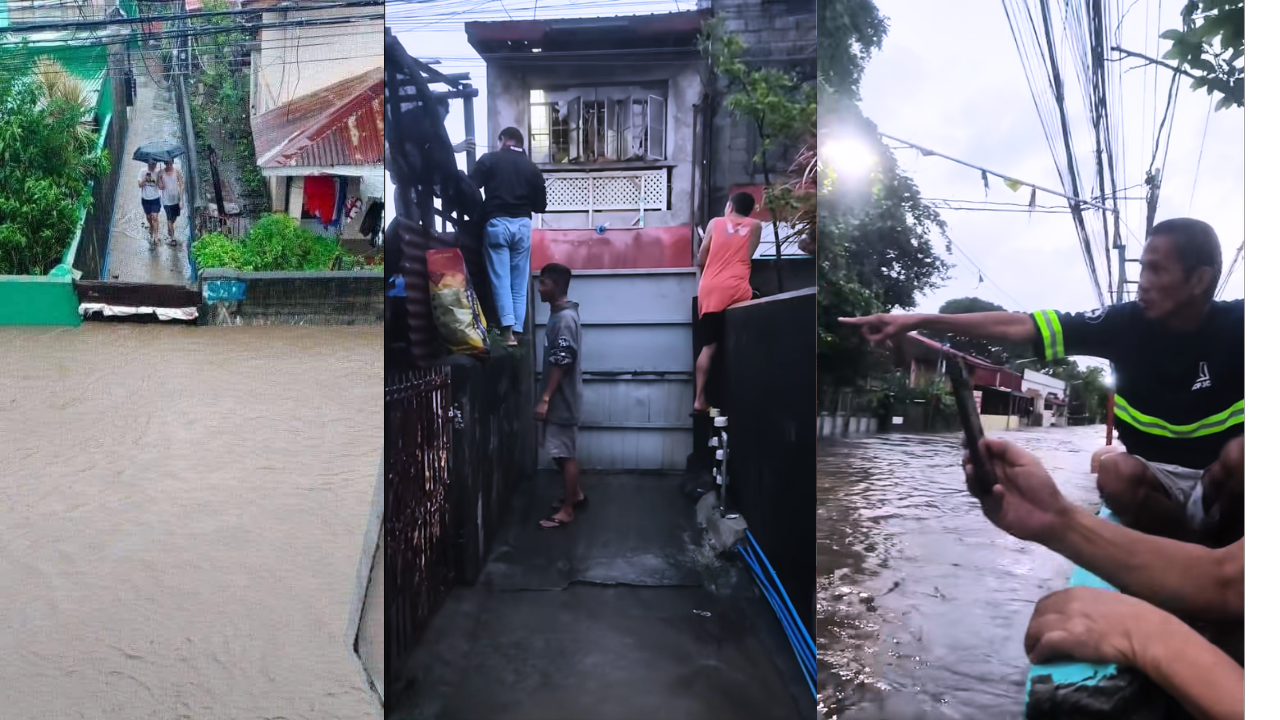
The habagat has a way of making familiar places unfamiliar.
In Noveleta, Cavite, the Ylang-Ylang River rises and roads turn into waterways. In Barangay San Antonio I, residents know what comes next: moving appliances, lifting mattresses, getting whatever can be saved above the waterline.
During the latest flooding, the water rose to more than six feet in parts of the neighborhood. But one residential alley had a plan for it: steel gates built by the people who live there.
It Started With One Gate
The first wooden version appeared in 2020, when one household tried to keep floodwater from coming through its doorway.
By 2023, King Nazareth Dayao Co’Arle had upgraded the design with a steel frame and rubber seals, making the barrier sturdier and tighter. What began as one household’s solution eventually became something bigger.
For 2026, the goal was simple: get gates to 50 residents in the community.
The funding mechanism was even simpler. Residents pooled money through a ₱5,000 ambagan, allowing more gates to be built along the residential alley.
Today, the barrier is no longer protecting just one house. Nearly every home in the neighborhood has one.
It isn’t a lone homeowner showing off a clever contraption. It’s an entire residential community building its own first line of defense.
And Dayao is careful about taking credit for the original idea.
“Actually ang gumawa po no’n, yung pamangkin ng asawa ko. Ako lang po yung nag-introduce paano siya gamitin, kung gaano siya ka-epektibo sa gano’ng kataas na baha.”
His wife’s nephew made the original gate, he explained. Dayao showed people how to use it and how effective it could be against floodwater that high.
The gate itself is remarkably ordinary.
Steel. A groove. Rubber or foam for a seal.
That’s it.
And during a flood that climbed past six feet, it was enough to keep the water on the other side.
But keeping the water out does not mean the people behind the gate stop worrying.
“Natatakot na may saya,” Dayao told ELYSPLANET.
He said the sheer volume of water is frightening, particularly because debris can still pose a threat to the walls protecting their homes. A large piece of timber carried by the flood could hit the structure and cause damage.
“Sana humupa na siya kasi po baka may dumaang malaking troso tumama sa pader namin at masira,” he said.
The relief comes from the other side of that equation.
“Masaya kasi hindi kami nabaha, hindi nasira ang pinaghirapan namin tulad ng mga gamit sa bahay.”
Even when the gate works, the flood is still very much there. The barrier simply gives the family a fighting chance to keep the damage outside.

The Neighborhood That Learned to Build Upward
The system works because the residents aren’t treating each gate as a separate purchase.
One house gets a gate, then another. The barriers begin to form a line along the alley.
Dayao’s videos show the process and the results, and the idea has since traveled well beyond the alley itself. Other flood-prone communities have taken notice.
That is partly why the story caught fire online. The gate isn’t particularly glamorous. The collective effort behind it is.
The Larger Flood
It would be easy to treat the video as another viral bit of Filipino ingenuity. But as we examined in our previous look at seasonal deluges over at Bad Weather, Noveleta is in the middle of a much larger flood emergency.
As of August 14, the National Disaster Risk Reduction and Management Council said more than 4.3 million people had been affected by the combined effects of the southwest monsoon and recent tropical cyclones. In Cavite, 23 local government units had been placed under a state of calamity.
The people behind this steel gate are not preparing for some hypothetical disaster. They are living through one.
The Philippines has spent years building and budgeting for flood-control infrastructure. In Noveleta, residents are still pooling ₱5,000 at a time to keep water out of their homes.
The Price of Protection
A house floods. The family builds a barrier. The barrier works. The neighbors see it. More neighbors get one.
That is a satisfying story on its own. The uncomfortable part comes when the ₱5,000 community effort is placed beside the country’s much larger flood-control spending.
In 2025, Greenpeace Philippines estimated that as much as ₱1.089 trillion in government climate-tagged expenditures could potentially have been lost to corruption since 2023, based on government climate-spending data and figures discussed during Senate inquiries.
The figure is an estimate, not a finding that the entire amount was stolen. Still, it is difficult to ignore the contrast: in Noveleta, residents are pooling ₱5,000 at a time to build the thing that keeps water out of their homes.
The irony doesn’t need much help.
A Barrier, Not a Miracle
The gates work, but Dayao knows they have limits.
Floodwater does not arrive alone. It carries branches, debris, and sometimes entire pieces of timber.
“Minsan may kahinaan po ‘yon dahil may time na may dumadaang troso mula sa taas, inaanod sa kalsada bago tatama sa pader. Ayon pwede mawasak yung pader, yun papasok yung tubig sa amin.”
Sometimes, he explained, logs carried downstream drift through the street and hit the wall. If the wall breaks, the water gets in.
It’s a useful warning against turning the viral video into a DIY engineering manual.
A barrier that holds during one flood is not automatically a substitute for engineered flood protection. Its performance depends on the structure around it, the pressure and duration of the water, and whatever the flood happens to carry into the street.
But the residents know what they’re trying to solve.
They know where the water enters. They know which openings need to be blocked. They know what happens when the river rises.
They have been learning it the hard way.
Flood. Clean up. Repair. Flood again.
So they built a gate.
The Noveleta Lesson
Dayao’s reason for documenting all of this is more personal than grand.
“Ang layunin ko po talaga ay maipakita ano yung kalagayan namin dito sa Noveleta, sa pamilya ko, sa magulang ko. Tapos tinuro ko na rin paano gamitin yung pangharang namin sa baha.”
His goal, he said, was to show what his family and parents were dealing with in Noveleta, and to teach others how to use their flood barrier.
The videos turned a household workaround into something larger: a record of what residents were doing for themselves, and a demonstration that the idea could be repeated.
But Dayao sees the experience as more than a demonstration of one household’s workaround.
“Para sa akin, hindi naman po natin kailangan asahan lagi ang pamahalaan.”
He acknowledged that government can fall short, but said that ordinary residents learn to find ways to protect their families when they are the ones directly exposed to the problem.
And the solution, in his telling, was never really just about the gate.
“Nagagawa po ito dahil sa pagtutulungan,” Dayao said. “Kami din ang apektado kung hindi kami magtutulungan.”
Dayao has encouraged other flood-prone communities to share whatever simple solutions work for them.
“Kung mayroon rin silang simpleng bagay na nakakapagtanggal ng baha, i-share din nila. Magtulungan tayo.”
If they have simple things that help deal with flooding, share them too. Help one another.
Today, it’s no longer about a single doorway or a single family. It is about an entire alley deciding, together, that the water will stop at the gate.
When the flood came again, the water rose outside the gates. It didn’t get in.

