
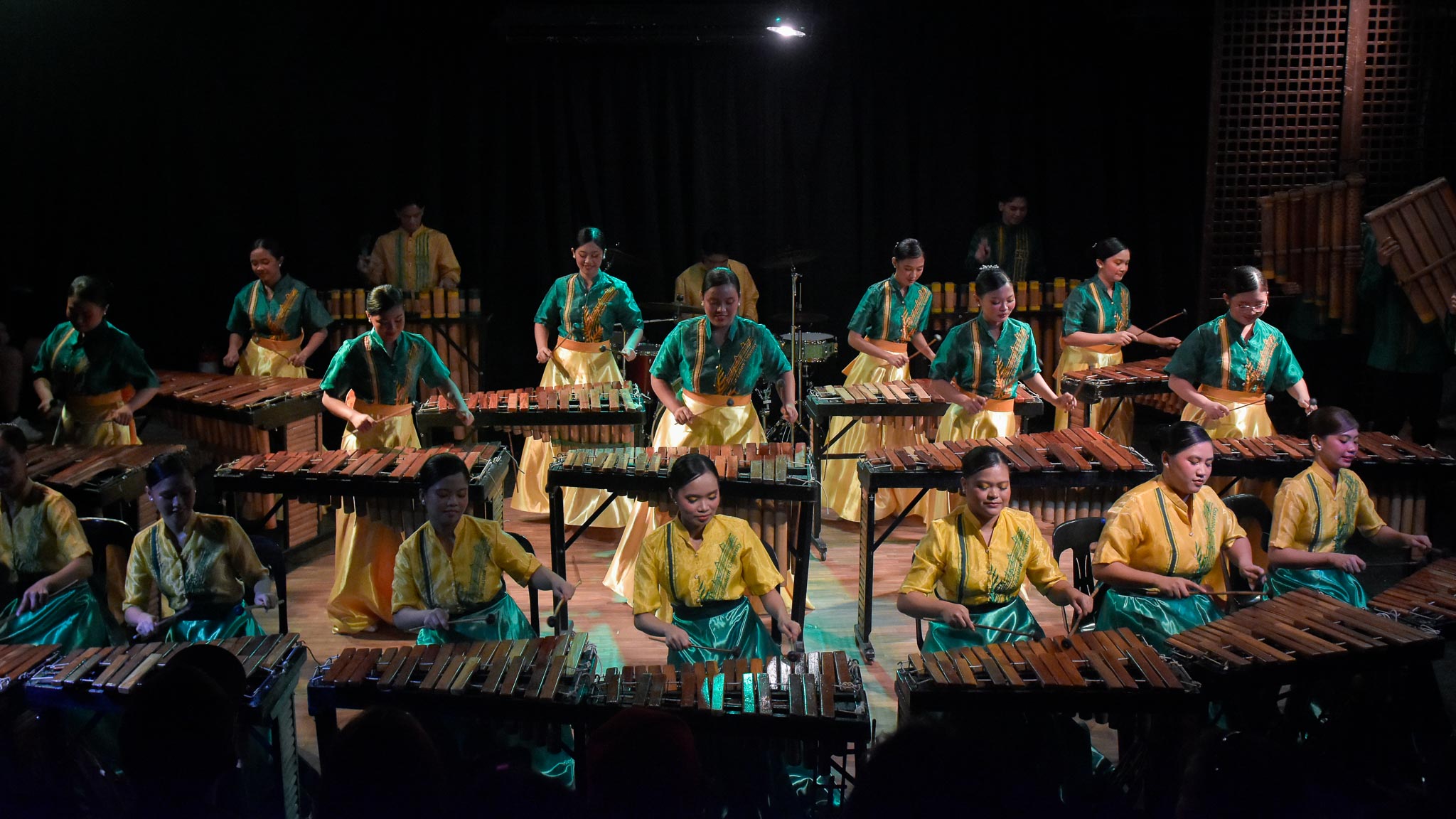
On September 26, a song banned under martial law will share a stage with a German rock ballad written for the fall of the Berlin Wall, a peace anthem born out of Jamaican reggae and adopted by Filipino street marches, and a chant from the Cordillera highlands that doesn’t translate cleanly into any other language. All four will be played on bamboo, by a band of nursing, architecture, and accountancy majors — none of them music students.
That’s “MALAYA: Songs of Freedom,” the latest concert from the Far Eastern University (FEU) Bamboo Band, running one hour starting 7:30 p.m. at the historic FEU Auditorium — once known as the “theater of all theaters” and the country’s cultural center back in the 1950s. It’s presented by the FEU Center for the Arts (FCA), the university’s dedicated arts-and-culture programming office.

A Grade-School Group That Outlasted Its Own Name
The group traces its lineage to FEU Pangkat Kawayan, a bamboo-instrument ensemble founded in FEU’s grade school in the 1960s and reorganized and renamed the FEU Bamboo Band in 2007. None of its current members are music majors — the roster spans nursing, medical technology, psychology, hotel and restaurant management, tourism, architecture, marketing, business, and accountancy programs — and they rehearse more than 12 hours a week on top of coursework.
Leading them is Norberto “Norbie” Cads Jr., the band’s longtime artistic director and a member of Banda Kawayan Pilipinas, a bamboo-music ensemble that has represented the Philippines at international festivals. Under Cads, the FBB has moved bamboo instruments well beyond folk repertoire: a full Beatles set in 2023’s “Let It Beatles,” a program of kundiman art songs the following year, and guest stages that have included the Cultural Center of the Philippines, Rizal Park, the Ayala Museum, and Malacañang Palace.

Freedom, Four Different Ways
Each of the four featured pieces carries its own history with freedom in the title or the story behind it.
“Wind of Change,” the Scorpions’ 1990 power ballad, grew out of the German rock band’s performance at the Moscow Music Peace Festival in 1989, months before the Berlin Wall actually came down. It went on to become the unofficial anthem of the end of the Cold War. “Kapayapaan,” by the pioneering Filipino reggae band Tropical Depression, has functioned less as a chart hit and more as a community song — a peace plea sung at progressive rallies and marches since the 1990s. “Salidumay” is a folk song genre from the Cordillera highlands of Northern Luzon, sung congregationally and treated by highlander communities as a marker of collective Cordillera identity; the word itself has no direct translation into English or Filipino. And “Freedom at Midnight,” an instrumental piece by jazz pianist David Benoit and bassist Nathan East, is the 1987 title track of the album that became Benoit’s commercial breakthrough.
The Voices Joining the Bamboo
Two collaborative numbers round out the program. The FEU Chorale joins the band for “Bayan Ko” (“My Country”), the kundiman that became one of the most politically loaded songs in Philippine history — banned from public performance after Ferdinand Marcos declared Martial Law in 1972, sung underground and in prisons through the dictatorship, and carried by crowds at both Ninoy Aquino’s 1983 funeral and the 1986 EDSA People Power Revolution that ended it.
The second is John Lennon’s “Imagine,” performed by Heleina Kirstensen Li, a student in FEU’s Institute of Arts and Sciences (IAS), Class of 2027, who’s also a member of the FEU Theater Guild — the same student theater company behind ElysPlanet’s recent coverage of MORYON, its 93rd-season opener staged inside Marinduque’s own Holy Week tradition.


If You Go
MALAYA: Songs of Freedom
📅 September 26, 2026, 7:30 p.m.
📍 FEU Auditorium, Far Eastern University, Manila
Tickets:
- Free — FEU community, with valid FEU ID
- ₱100 — FEU alumni, with valid FEU ID
- ₱200 — Non-FEU community (50% discount for non-FEU students with valid ID; 20% discount for senior citizens and PWDs with valid ID)
It’s the FEU Bamboo Band’s first program built explicitly around the theme of freedom, coming just under two decades after the group took its current name in 2007.