
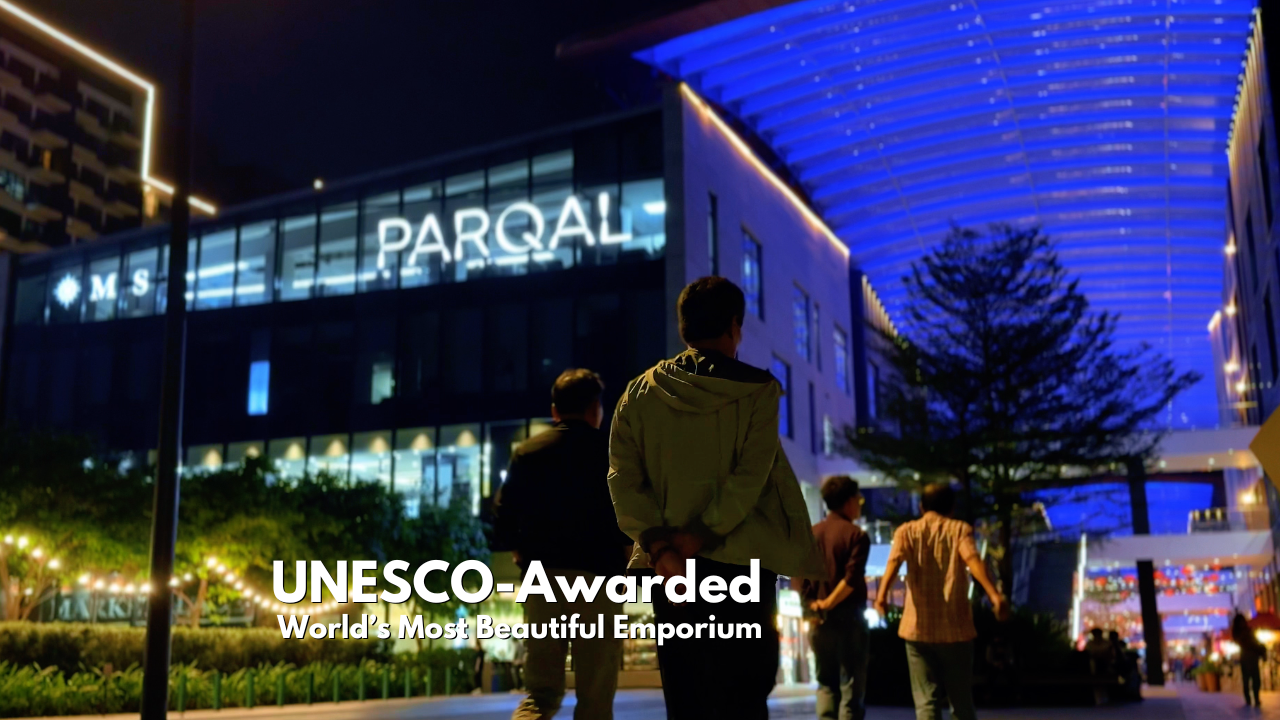
Most Manila malls are built to move you — through a door, past a display, toward a register. Parqal, the mixed-use development sitting at the center of Aseana City in Parañaque, was built to do the opposite. It’s a five-hectare complex of shaded, arcaded walkways connecting nine low-rise buildings, and its whole design brief was reportedly to get people to slow down and actually exist in a space instead of just passing through it. That’s a strange thing to build in a city this transactional. It’s an even stranger thing to build next to a visa application center.
A Mall Engineered to Make You Stop
The name is a wordplay — “park” plus “kalye,” Filipino for street — and it holds up better than most developer branding usually does. Parqal earned a 5-Star BERDE Certification, the Philippine Green Building Council’s highest sustainability rating, largely for a long, sunroofed canopy that keeps the walkways climate-protected without leaning entirely on air-conditioning — a real departure from how most Metro Manila retail survives the heat, which is usually by sealing people inside a box and cranking the AC until it’s arctic. Underneath that canopy, the air actually moves differently. The temperature genuinely drops a few degrees just from the shade and airflow design, which sounds like a small thing until you remember how rare it is to feel a building working with the heat instead of just blasting past it.
The architecture leans into a modernized version of the bahay-na-bato, the old Spanish-colonial-era Filipino house style, filtered through Chinese-influenced lines and translated into steel, wood, and stone for a nine-building commercial complex. Repetition does a lot of the work here — the same materials showing up again in different proportions down the length of the walkway, which is less about décor and more about giving your eyes a rhythm to follow while you walk instead of rushing.
That’s the pitch, and mostly it works: a stretch of Metro Manila where you don’t need a receipt to justify standing still. No purchase required, not even a coffee. Just the sound of your own feet on stone, with the noise of Macapagal Boulevard on one side and Diokno Avenue on the other fading into the background the deeper in you walk.
I happened to be there right as the sun was going down, walking slowly on purpose, and the overhead panels along the canopy caught it — shifting through the same gold-and-orange gradient bleeding across the actual sky above them, so the light overhead and the light filtering through felt like they were having a conversation with each other. It’s one of the more quietly beautiful things I’ve stood in the middle of these past few years, which is a strange thing to say about a mall. It’s easy to be cynical about architecture engineered to do exactly that on cue. It’s a lot harder to stay cynical while you’re actually standing in it, watching it happen.

The Room Where Everyone’s Waiting to Leave
And then there’s Building 5.
Level 3 of Parqal’s Building 5 houses a visa application center run by VFS Global, currently processing Japan visa applications for the Philippines — one of several outsourced visa centers now operating out of the complex, alongside similar operations in other Parqal buildings serving other countries’ consular needs. It’s not a footnote. It’s the specific reason a meaningful share of the people walking Parqal’s shaded promenade on any given weekday aren’t there for the architecture at all. They’re there for a stamp.
There’s a genuine tension in that pairing that the developers almost certainly didn’t intend as commentary, but it reads as one anyway. Parqal is designed, structurally and materially, to make people want to stay in it — to slow their walk, to notice the wood grain, to treat the street itself as the destination rather than a hallway between two more important places. And tucked inside one of its nine buildings is a room built entirely around the opposite impulse: filling out forms, paying a service fee, waiting for the one document that lets you go somewhere else.
It’s worth being accurate about where the Philippine passport actually stands right now, since the number matters more than the vibe here. As of the Henley Passport Index’s most recent 2026 edition, released in July, the Philippines ranks 72nd globally — tied with Benin and Uganda — offering visa-free or visa-on-arrival access to 65 destinations. That’s a real if modest improvement, up from 73rd earlier in the year, and part of a slow multi-year climb back from a low point during the pandemic years. It’s not a dramatic leap. It’s incremental, the kind of progress that shows up in a spreadsheet before it shows up in anyone’s actual travel plans. Which makes Building 5 a strange kind of honest monument: proof that for a lot of Filipinos, “getting somewhere else” still runs through paperwork and patience before it runs through an airport gate.
Two Buildings, One Complex, Two Definitions of Freedom
None of this makes Parqal’s design ambition less real. If anything, it sharpens it. A shaded street built specifically so people don’t feel rushed sits a few hundred meters from a room built specifically because people need to leave — and Aseana City, the 107-hectare reclaimed bayfront estate Parqal anchors, has its own complicated relationship with land and access worth its own conversation (we’ve covered some of that reclaimed-coastline tension already, in the piece on SM Mall of Asia, a short drive up the same stretch of bay).
What Parqal actually gets right is smaller and harder to fake: it’s one of the only pieces of commercial Manila built around the idea that walking somewhere slowly is worth designing for, not just tolerating. Whether the people doing that walking are there to linger or there because Building 5 needed their documents that day, the canopy doesn’t discriminate. It just keeps the heat off both of them the same way.
Field Notes
Parqal — Aseana City, Barangay Tambo, Parañaque. Open-air complex, generally accessible around the clock; individual retail and dining hours vary by tenant, typically running late morning through late evening.
VFS Global visa centers, Building 5 — currently handles Japan visa applications for the Philippines (Level 3), among other consular processing operations based in the complex. Appointments are booked online in advance, not walk-in; expect a center usage/service fee on top of the destination country’s own visa fee.
Getting there: the Aseana City Loop shuttle connects Parqal to Parañaque Integrated Terminal Exchange (PITX) and SM Mall of Asia — useful if you’re pairing this stop with the sunset-and-bay-walk piece we’ve already written on Mall of Asia. By car, Parqal sits at the corner of Diokno Avenue and Macapagal Boulevard; parking is available on-site.
Worth knowing: Aseana City is a reclaimed bayfront development, part of the same broader wave of reclamation projects reshaping Manila Bay’s coastline — worth reading alongside the Mall of Asia piece if you want the fuller picture of what that reclamation actually costs the mainland.
Budget (PHP)
- Walking Parqal’s promenade: ₱0 (free, no purchase required)
- Al fresco dining/café stop: ₱200–₱500 per person
- VFS Global visa center service/usage fee (Japan visa, separate from the visa fee itself): ₱520
- Aseana City Loop shuttle: check current fare on boarding; historically a low, flat fee
We shot the footage behind this piece earlier this year — the canopy, the walk, the quiet contrast between the two buildings described above. If you want the visual side of it, the video’s still up here.
Pingback: The Philippine Passport Fee Could Rise to ₱1,500. The DFA Wants to Wait Until 2028. | ELYSPLANET