
BGC has gates. Mall of Asia has a horizon — and in a city that spends most of its energy deciding who gets to stand where, that difference is the whole story.
Walk through Bonifacio Global City and the message is subtle but constant: this is curated, and curation has a dress code. Walk onto the reclaimed edge of Pasay where SM Mall of Asia meets the bay, and the message flips. Sixteen-plus hectares of mall, an open bay walk, food stalls that don’t card your income bracket, and a sunset that performs the same show for the guy who took two jeeps and a footbridge to get here as it does for whoever just closed a deal in the offshore casino down the road. For a father commuting in from Caloocan or Novaliches with a kid on his hip, this isn’t a weekend outing. It’s a pilgrimage to one of the only stretches of premium Metro Manila that was never built to keep him out.
That contrast — gated exclusivity on one side, unapologetic public joy on the other — is the actual hook here, and it’s worth sitting with longer than the mall’s own marketing ever does. BGC is a city of gates, the kind where a worker in the wrong shoes can feel the judgment before anyone says a word. Mall of Asia is the opposite bet: no cover charge on the view, no dress code on the bay walk, and a crowd that skews toward exactly the people BGC’s polish quietly filters out. Filipinos also have a habit of wanting superlatives, not just amenities — not just a mall, but one of the largest on the planet, at over sixteen hectares. That scale is part of the draw, but it’s not the point of this piece. The point is what that scale made possible: a version of “premium” that didn’t end up gated.
Built on Borrowed Sand
Mall of Asia was a pioneer. Long before anyone drafted a 2035 skyline for Manila Bay, this structure proved a simple, profitable idea: pave the sea, and people will come. That idea has since scaled far past one mall. Look at what’s currently rising out of the water along this same coastline — the 360-hectare SM Smart City, the 419-hectare Horizon Manila with its three artificial islands and a four-kilometer canal park, Manila Waterfront City, and a 2,500-hectare Aerotropolis taking shape up in Bulacan. Put together, developers and the national government — because these are state-approved projects, not just private land grabs — are positioning this coast to rival Shenzhen’s Qianhai district or Singapore’s Marina Bay by 2035: a continuous, interconnected mega-city built entirely on reclaimed ground.
The cost of that ground doesn’t stay offshore. Dumping millions of tons of sand blocks the natural outfalls of Manila’s rivers and compresses the seabed, which sinks the coastline it’s supposed to be elevating. When monsoon season hits, water that used to drain now has nowhere to go — a problem compounded by flood-control budgets that have a well-documented habit of disappearing into the wrong pockets. Fishing communities that depended on these waters for generations are displaced to make room for the view. The skyline gets its Singapore. The mainland gets the runoff.
It’s worth being direct about who’s driving this, because the instinct is to blame a faceless developer. These aren’t rogue private projects slipping past regulators — they’re state-approved visions, actively marketed as the country’s economic future. That framing matters for a piece like this one, because it means the tradeoff described here — dazzling skyline, sinking mainland, displaced fishing communities — isn’t an accident of the market. It’s policy.

The Rooftop Compromise
Mall of Asia’s own answer to a vanishing shoreline is almost a small confession: a rooftop park, complete with artificial grass and manicured gardens, built on top of the concrete that replaced the coast in the first place. It’s nature, simulated, stacked over the nature it displaced — and it shouldn’t work as well as it does.
Because up on that rooftop, the crowd tells a different story than the reclamation math does. There’s a real mix of Metro Manila up there — including, easily, a father who’s worked six days a week at minimum wage to be standing at that railing with his kid. Walk into a BGC café in that same outfit and the reception runs cold. Up here, leaning against the glass with the bay wind cutting the heat, he’s not being rushed or side-eyed. He’s just watching the same view everyone else paid the same bus fare to see. That’s the democratizing part — and it’s also the uncomfortable part, because the ground under his feet is the same reclaimed ground that cost a fisherman his livelihood. In this particular pocket of Manila, joy and displacement are built from the same sand.
The One Thing Still Free
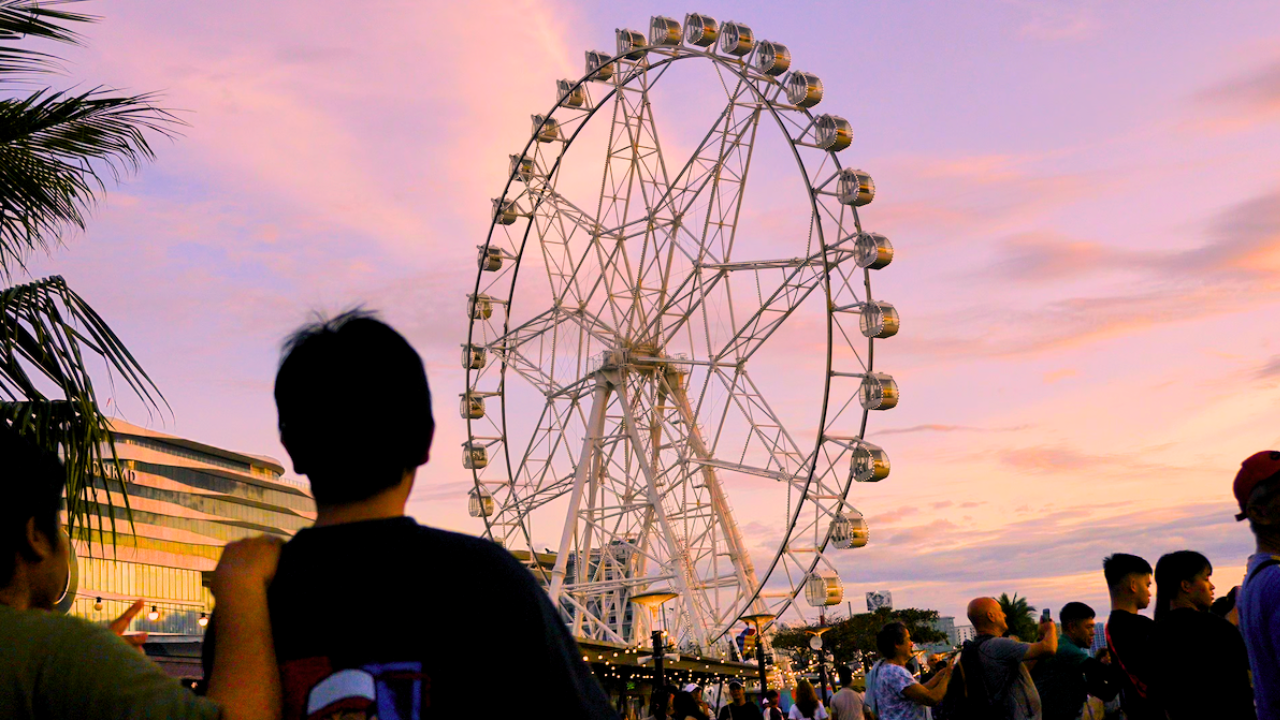
Every evening, the same show runs: the sun drops behind the silhouettes of the new artificial islands and throws an orange that doesn’t care who’s watching. It plays for the high roller in the casino across the water and the exhausted commuter on the public deck with identical intensity — which, in a city this obsessed with who owns the land and who gets the corner office, might be the closest thing left to a truly public good.
BGC is the polished, exclusive version of Manila’s future — clean, orderly, built for the few who can afford the entry fee. Mall of Asia is the messier, louder rehearsal of what actually keeps a city like this livable: a place that doesn’t ask what you’re wearing before it lets you watch the sunset.

Field Notes
A few things have moved since the trip behind this piece, worth knowing before you go: MOA Eye tickets now run ₱200 for a regular cabin and ₱250 for the glass-floor VIP cabin, this year’s Pyromusical Competition already wrapped its Saturday-night run (it closed April 11 and won’t be back until early next year), and the rooftop park — officially MOA Sky now — has settled into a genuine fixture rather than a novelty add-on. The bay walk is still free. The sunset still doesn’t check IDs.
Getting there: From the north or central Metro, take LRT-1 to the EDSA or Taft Avenue stations, then transfer to a jeepney, bus, or point-to-point van bound for Mall of Asia / Seaside — the whole ride is doable for well under ₱100 if you’re commuting the way most of the crowd in this piece does. By car, the mall sits off Coastal Road and Roxas Boulevard, with paid parking on-site.
Best spots:
- The bay walk and Seaside food strip — open-air, budget-friendly food stalls facing the water, best around late afternoon before the crowd builds for sunset.
- MOA Eye — the mall’s Ferris wheel, best boarded right as the sun starts dropping for the same view from height.
- MOA Sky (the rooftop park) — over 60,000 square meters of open-air deck above the mall proper, free to enter, now built out with an amphitheater, a football pitch, and a small quiet space called the Sanctuary alongside the original green lawn — the spot for the “everyone gets the same view” moment described above.
- Pyromusical / fireworks shows — an annual competition, typically running Saturdays from mid-to-late February through early-to-mid April; outside that window there’s no show on Seaside Boulevard, so check current-year dates before building a trip around it rather than assuming it’s running.
Hours: Mall proper generally runs 10 AM to 10 PM daily; the open bay walk and rooftop areas stay accessible into the evening for sunset and post-sunset crowds. Confirm current hours before a visit, as extended hours for specific venues can shift.
Budget (PHP)
- Commute (jeepney/bus/LRT combo from northern Metro Manila): ₱50–100 round trip
- Food stall meal (Seaside strip): ₱150–300 per person
- MOA Eye ride: ₱200 (regular cabin) / ₱250 (VIP glass-floor cabin)
- MOA Sky rooftop park entry: free
- Parking (if driving): ₱40–60/hour
We shot the footage behind this piece earlier this year — the rooftop crowd at MOA Sky, the sunset over the reclaimed islands, the bay walk that never once asked anyone what they were wearing. If you want the visual feel of what’s described above, the video’s still up: watch it here.
Pingback: Inside Parqal, Where Half the Visitors Are Trying to Leave the Country | ELYSPLANET