
On Monday he landed on his back and barely made the final. On Friday he won it.
On Monday, Carlos Yulo’s hand slipped on the table during his first qualifying vault at the Nagoya City General Gymnasium, and he came down flat on his back. That vault scored 13.166. He needed his second attempt to scrape into the eight-man final in seventh, the lowest seed a reigning Olympic vault champion could reasonably expect to hold.
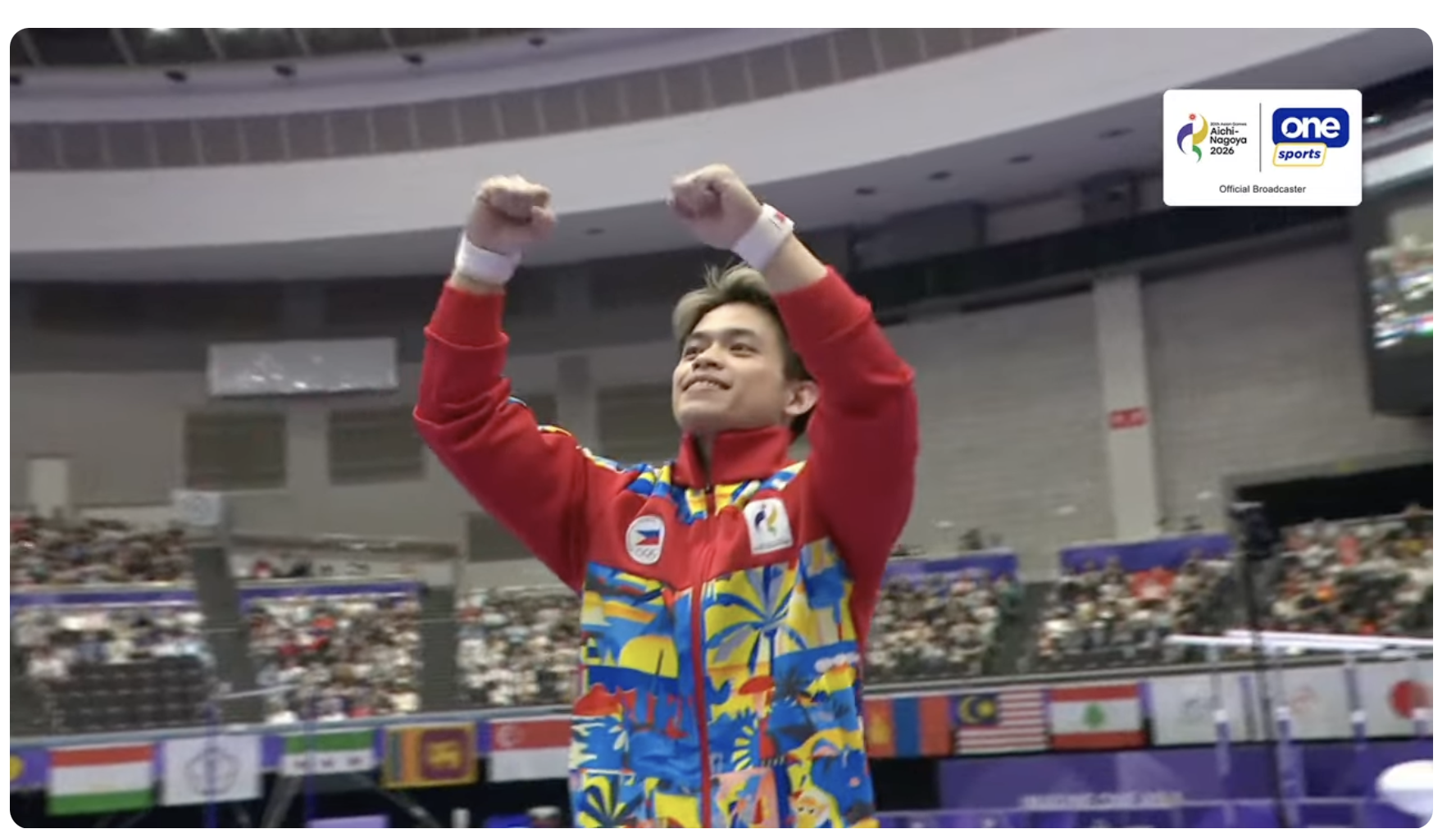
On Friday, September 25, he won it. Yulo scored 14.733 and 14.466 on his two vaults for an average of 14.599, holding off Iran’s Mahdi Olfati (14.533) and Hong Kong’s Ng Ka Ki (14.116) for his second gold of the 2026 Asian Games in as many days.
Then there’s the margin. Yulo beat Olfati by 0.066 points. On Thursday he beat Kazakhstan’s Milad Karimi for floor exercise gold by the same 0.066 points. Two golds in two days, both won by the same sliver.
The Vault He Couldn’t Accept
Monday’s qualification round, which also served as the individual all-around, was the roughest day of Yulo’s week. Besides the vault, he fell on the horizontal bar and finished tenth in the all-around. His second vault, a 14.133, brought his average to 13.649. After that he could only wait for the second subdivision to finish and hope the gymnasts in it didn’t push him out of the top eight. Only one of them, South Korea’s Kim Jaeho, passed him.
He wasn’t diplomatic about it afterward. Speaking to the Philippine Olympic Committee (POC) media pool, he admitted he couldn’t accept how the vault had gone (“hindi ko siya matanggap”).
That makes the recovery the real story. On Wednesday, in the team final, Yulo went back to the same difficult vault that had thrown him on Monday and landed it, finishing with the fourth-highest vault score of the day. By Friday he was steady enough to win the event.
How a Vault Final Is Scored
Unlike the other apparatus finals, a vault final asks each gymnast for two different vaults, and the gold goes to the best average of the two. Each vault is scored like the rest of gymnastics: a difficulty score for how hard the skill is, plus an execution score out of 10 that loses points for bent legs, loose form, or an unsteady landing. Penalties, such as landing outside the marked area, come off the total.
Olfati threw the single best vault of the night, a 15.100 that no one else came close to. His problem was the second one: a 13.966, with a 5.2 difficulty score, an 8.866 execution score, and a 0.1 penalty. Yulo never matched Olfati’s high, and didn’t need to. His weaker vault, a 14.466, was still half a point better than Olfati’s weaker one, and on a two-vault average that consistency decided the gold. Ng, the top qualifier on Monday at 14.166, took bronze. South Korea’s Kim Jaeho, the only gymnast from Monday’s second subdivision to outscore Yulo in qualifying, finished fourth with 14.016.

A Rematch From Paris
This is not the first time Yulo and Olfati have met in a vault final. At the Paris 2024 Olympics, where Yulo won gold on both floor and vault, Olfati became Iran’s first men’s vault finalist in 60 years and finished second-to-last. Two years later in Nagoya he was the one pushing Yulo hardest for gold.
Yulo has a habit of winning vault titles this narrowly. His 2025 World Championship vault gold in Jakarta came by 0.033 points over Armenia’s Artur Davtyan.
Two Filipinos in the Top Five
Yulo wasn’t the only Filipino in the final. Juancho Miguel Besana, the 2023 Southeast Asian Games vault champion, who qualified fourth on Monday, finished fifth with 13.783. His two vaults, 13.766 and 13.800, were nearly identical.

What It Adds Up To
Yulo arrived in Nagoya without an Asian Games medal of any kind. He leaves with two golds, on the two apparatuses where he’s the reigning Olympic champion. His Games ended later that afternoon with a fourth-place finish in the parallel bars final, 0.133 points off the bronze. His younger brother, Karl Eldrew Yulo, took bronze on the horizontal bar the same session.
The golds also count toward the POC’s target of eight for these Games, double the country’s best Asian Games gold haul since the 1950s. Under Republic Act No. 10699, the National Athletes and Coaches Benefits and Incentives Act, an Asian Games gold is worth ₱2 million in government incentives. ElysPlanet’s running hub on the Philippines’ 2026 Asian Games campaign has the updated medal count and what’s still to come before the October 4 closing ceremony.
Pingback: Carlos Yulo Wins 2026 Asian Games Floor Exercise Gold — the One Title His Collection Was Missing | ELYSPLANET
Pingback: The Philippines Wants 8 Golds at the 2026 Asian Games. Carlos Yulo Just Delivered the First. | ELYSPLANET