
On September 24, six days into a campaign that closed October 4, two-time Olympic champion Carlos Yulo won the men’s floor exercise in artistic gymnastics. A day later he added the vault. On September 29, pole vaulter EJ Obiena defended the title he won at Hangzhou. On October 2, 22-year-old Jeus Yape won mixed virtual taekwondo, the Philippines’ first Asian Games taekwondo gold. When the Games closed, the final count stood at four gold, nine silver and 16 bronze, 29 medals in all, good for 16th on the medal table and more medals than the country won at any of the last five Games.
The silvers belong to mixed martial artist Jean Claude Saclag; the Gilas Pilipinas Women’s 3×3 team of Kacey Dela Rosa, Amyah Espanol, Kennan Ka and Maria Pasilang; the women’s sepak takraw doubles team of Jean Marie Sucalit, Abegail Sinogbuhan and Nelly Jay Salon; archer Amaya Amparo Cojuangco; taekwondo jins Juliana Candelaria, Tachiana Mangin and Kurt Barbosa; boxer Carlo Paalam; and jiu-jitsu’s Alexandria Enriquez.
The bronzes belong to the women’s soft tennis team of Princess Catindig, Bien Zoleta, Noelle Mañalac, Christy Sañosa, Shyryn Salazar and Hilary Paas; mixed martial artist Carlos Alvarez; the women’s team kata trio of Rebecca Cyril Torres, Samantha Veguillas and Ysabelle Arrogante; karateka Marie June Adriano; 18-year-old gymnast Eldrew Yulo; weightlifter Albert Ian Delos Santos; hurdler John Cabang Tolentino; the two SIBOL esports squads, in Pokémon UNITE and Honor of Kings; the men’s sepak takraw regu team; surfer Jayuard Alciso; middle-distance runner Victoria Bossong; tennis player Alex Eala; taekwondo jin Jeus Yape in men’s individual poomsae; beach volleyball’s Khylem Progella and Sofiah Pagara; and jiu-jitsu’s Kaila Napolis.
The Philippine Olympic Committee’s target was eight golds. The country finished with four, the same as Jakarta-Palembang 2018 and Hangzhou, and placed fourth among Southeast Asian nations, behind Thailand, Malaysia and Indonesia. Five would have been its first haul that size since 1962. Paalam and Enriquez each lost a gold-medal match by the narrowest of margins, a 3–2 split decision and an advantage-point call.
This hub was updated through the October 4 closing ceremony. Each Philippine gold has its own coverage, linked in the sections below.

History Says Nobody Should Be Surprised by a Slow Start
The Philippines has competed in all 19 editions of the Asian Games since 1951, accumulating 71 gold, 116 silver, and 241 bronze medals — 12th all-time in golds, well behind China, Japan, and South Korea. Almost half of that gold total, 35 of the 71, came in just the first four editions, from New Delhi 1951 through Jakarta 1962. Hosting the Games in Manila in 1954 produced the country’s best-ever showing: 14 gold, 14 silver, and 17 bronze, good for second place overall behind Japan. The Philippines hasn’t won more than four gold medals at a single Asian Games since. Boxing (15 golds) and track and field (12) remain the two sports that have produced the bulk of the country’s all-time medal count; the last edition, Hangzhou 2022, matched the modern-era ceiling with four gold, two silver, and 12 bronze — including EJ Obiena’s pole vault win, the first gold of that campaign.
Read against that history, a target of eight golds isn’t a modest ask — it would be double the country’s best showing since the 1950s. A slow first few days fits the historical pattern more than it breaks from it.
How the Medals Came In
The First Medals: Mixed Martial Arts, Kata, and 3×3
Mixed martial artist Jean Claude Saclag came closest to one of the combat-sports golds the eight-medal target was built around, beating Japan’s Daisuke Murayama to reach the men’s traditional -65kg final before losing 3-0 to Tajikistan’s Otabek Rajabov on September 22. His silver was the country’s first of these Games. The same day, Rebecca Cyril Torres, Samantha Veguillas, and Ysabelle Arrogante took bronze in women’s team kata, the Philippines’ first-ever Asian Games medal in that event. Gilas Pilipinas Women’s 5-on-5 team opened 2-0 in group play, then went out in the quarterfinals to Chinese Taipei, 83-71, the second straight Asian Games where they fell one win short of a first-ever final four. The 3×3 women’s team went further. On September 25, Kacey Dela Rosa, Amyah Espanol, Kennan Ka and Maria Pasilang lost the gold-medal game to host Japan, 21-11, but the silver was the Philippines’ first Asian Games medal in 3×3 basketball.
Kayla Sanchez: Fourth Place, Three Times
Swimmer Kayla Sanchez, a two-time Olympic medalist for Canada before switching to represent the Philippines, has become the campaign’s most painful near-miss. She broke her own Philippine record twice in the women’s 50-meter backstroke on September 21 and finished fourth, then finished fourth again in the 100-meter freestyle a day later, 0.18 seconds off the bronze. Her coaches held her out of the 100-meter backstroke on September 23 to save her for the 50-meter freestyle, her strongest event. On September 24 she finished fourth a third time, in 24.75 seconds, 0.29 behind China’s Cheng Yujie for bronze. China’s Wu Qingfeng won in 23.98, a new Games record. A podium finish would have been the Philippines’ first Asian Games swimming medal since Raymond Papa’s two backstroke bronzes in 1998.

The Yulo Brothers: Two Golds and a Bronze Nobody Expected
Gymnast Carlos Yulo, the reigning Olympic champion in floor exercise and vault, turned a shaky start into the campaign’s breakthrough. In the September 21 qualification round, he botched the grab on his first vault and hit the mat, then fell again on the horizontal bar while attempting a skill he had dropped for years and brought back to test himself. Afterward, he said he was grateful just to walk away uninjured, because that kind of mistake “could have ended my career.” He still topped the floor qualification with 14.600 points, and three days later he converted it: 14.666 in the September 24 floor final, edging Kazakhstan’s Milad Karimi (14.600) and Japan’s Shoma Tsukiyama (14.566) for the Philippines’ first gold in Nagoya — and the Asian Games title that had been the one gap in a trophy case already holding Olympic, World Championship, Asian Championship, and Southeast Asian Games golds. His 18-year-old brother Eldrew, in the same final, finished seventh.
A day later, on September 25, Carlos won the vault he had fallen on in qualifying, averaging 14.599 to beat Iran’s Mahdi Olfati (14.533) and Hong Kong’s Ng Ka Ki (14.116) by the same 0.066-point margin as his floor title. Teammate Juancho Miguel Besana finished fifth in the same final. Later that afternoon he closed his Games fourth on parallel bars with 14.300, 0.133 behind bronze medalist Rasuljon Abdurakhimov of Uzbekistan. He said he’d gone into the routine “just enjoying it” after two finals’ worth of pressure. Eldrew gave the family a third medal in the same session. He had finished ninth in qualifying, and nobody expected him on the podium. In the horizontal bar final he tied Kazakhstan’s Milad Karimi at 13.666 and took the bronze on a higher execution score, 8.566 to 7.766, behind China’s Tian Hao (14.700) and Japan’s Shinnosuke Oka (14.033).
Albert Ian Delos Santos: A Junior World Record for His Father
The tenth medal came on September 26 from weightlifter Albert Ian Delos Santos. He was the youngest in a nine-man field in the men’s 70kg and was also one of the country’s opening-ceremony flag bearers. He snatched 141 kilograms. In the clean and jerk he broke his own junior world record twice on his last two attempts, 181 and then 183 kilograms, for a 324-kilogram total, six clear of Uzbekistan’s Adkhamjon Ergasev in fourth. He dedicated the bronze to his late father and longtime coach, Alvin, who died of liver cancer in March.

John Cabang Tolentino and SIBOL: Three Bronzes in Two Days
Three more bronzes came in less than two days. On September 27, John Cabang Tolentino ran a season-best 13.48 seconds in the men’s 110-meter hurdles for bronze, behind China’s Chen Yuanjiang and Japan’s Rachid Muratake. He had finished fourth at Hangzhou, and the medal made him the first Filipino man to reach an Asian Games hurdles podium since 1954. The same day, SIBOL, the national esports team, took bronze in Pokémon UNITE, a team-based battle game, after losing its semifinal to Indonesia. The squad, led by Ducke Leoncio, Lawrence Gatmaitan and Robert Mempin, won the Philippines’ first-ever Asian Games esports medal. SIBOL’s Honor of Kings crew of Dragon Hart Dajao, Golden Hart Dajao, Charles Roman Esguerra, Chammy Paul Nazarrea, Justine Ritchie Tan and Jhon Mike Tungol, playing a five-on-five mobile battle game, swept South Korea to reach the final four, then lost 2-0 to China on September 28 and settled for a second esports bronze.
Sepak Takraw: A First Women’s Medal, and a Final
Also on September 28, the men’s regu team reached the semifinals of sepak takraw, the volleyball-style sport played with the feet, and took bronze in the three-a-side event, matching the country’s finish at Hangzhou. The women’s doubles team of Jean Marie Sucalit, Abegail Sinogbuhan, and Nelly Jay Salon beat Laos, 15-12, 15-10, to reach the final, then lost the gold-medal match to Vietnam on September 29, 15-8, 15-4. The silver is the first Asian Games medal ever for Philippine women’s sepak takraw, and the country’s best finish in the sport since it joined the Asian Games program in 1990.
Jayuard Alciso and Victoria Bossong: Two Bronzes on September 29
September 29 added two more bronzes on top of the sepak takraw silver. In the men’s shortboard, the high-performance surfing format built around short, maneuverable boards, 21-year-old Jayuard Alciso beat fellow Filipino Toby Espejon in an all-Philippine bronze-medal heat, scoring 11.64 off two waves (6.67 and 4.97) for the country’s first surfing medal of these Games. That evening, Filipino-American runner Victoria Bossong, who had won her 800-meter heat a day earlier in 2:02.34, clocked 2:05.34 in the final for bronze, behind China’s Wu Hongjiao (2:04.49) and Bahrain’s Nelly Korir (2:05.16). It is athletics’ second medal in Nagoya after Tolentino’s, from a runner who broke the Philippine 800-meter record in July with 2:01.55.
EJ Obiena: A Title Defended, and His Own Record Broken
The third gold came the same evening, from the athlete who won the last one. Pole vaulter EJ Obiena, the Asian record holder at 6.00 meters, defended his Hangzhou title at Nagoya City Mizuho Park Athletic Stadium. He passed the opening heights, made 5.50 on his first attempt, skipped 5.60, then cleared 5.70 and 5.75 on first tries as well.
China’s Yao Jie went out at 5.75. The real pressure came from Yao’s teammate Li Chenyang, ranked 20th in the world to Obiena’s 11th, who passed at 5.75 and gambled on 5.80. Li missed there with every attempt he had left, and the gold was Obiena’s. He kept going anyway, and on his final attempt of the night he cleared 5.91 meters, one centimeter above the 5.90-meter Asian Games record he set at Hangzhou and a match for his season best. It was the Philippines’ first gold outside gymnastics in Nagoya and athletics’ first, and it made Obiena the first Filipino track-and-field athlete to retain an Asian Games title since sprinter Lydia de Vega in 1986.
The Asiad was expected to close a season in which he had already won nine golds.

Boxing: Carlo Paalam’s Silver Is the Team’s Only Medal
The combat-sports half of the eight-gold plan hung on the ring early. Nesthy Petecio, silver medalist at Tokyo 2020 and bronze medalist at Paris 2024, lost a unanimous decision to China’s Chengyu Yang in the women’s 60kg quarterfinals. Docked a point for holding in the first round, she never found a way inside the taller fighter’s reach, and the Asian Games remain the one major tournament where she has never medaled.
Junmilardo Ogayre had gone out earlier at 60 kilograms to Uzbekistan’s Abdumalik Khalokov, the reigning Olympic champion, and Paris bronze medalist Aira Villegas lost to an Indian opponent before that. That left Carlo Paalam. Returning from a year-long injury layoff, he beat India’s Jadumani Mandengbam on three of five scorecards, outpointed China’s Zhang Jiamao in the 55kg quarterfinals, then beat Kazakhstan’s Makhmud Sabyrkhan, a two-time world champion, 3-2 in the semifinals. On October 2 he lost the final to Japan’s Rui Yamaguchi, the reigning Asian champion, by the same 3-2 split decision, even though he won the third round unanimously. The silver was the boxing team’s only medal of the Games and left the Philippines without a boxing gold since 2010.
Alex Eala: Bronze, After a 5-0 First-Set Lead
Alex Eala landed in Nagoya as the top seed in women’s singles and took a first-round bye. She beat Thailand’s Patcharin Cheapchandej and then Chinese Taipei’s Joanna Garland to reach the semifinals, which guaranteed a medal. On October 1 she lost there to China’s Wang Xiyu, ranked 85th in the world, 6-3, 3-6, 2-6, after racing to a 5-0 lead in the first set. The bronze is her third Asian Games medal, after singles and mixed doubles bronzes at Hangzhou. She is next due at the Wuhan Open, which starts October 12.
Taekwondo: Forty Years Without a Gold, Then Four Medals in Two Days
Taekwondo joined the Asian Games in 1986. Before Nagoya, the Philippines had won four silvers and 25 bronzes in the sport and no gold. Jeus Yape ended that on October 2, beating Vietnam’s Chau Ngoc Tuyet Sang, 2–0, in virtual taekwondo, a new event where athletes in VR headsets and motion sensors fight as on-screen avatars. It was his second medal in two days, after bronze in men’s individual poomsae, the form-based discipline. Hours later, 18-year-old Tachiana Mangin lost the women’s 49kg kyorugi (free sparring) final to China’s Ma Jingyue, 2–0. Kurt Barbosa lost the men’s 58kg final to Kazakhstan’s Tamirlan Tleules, 2–0. Juliana Candelaria had taken silver in women’s individual poomsae a day earlier. Taekwondo’s haul: one gold, three silvers, one bronze.
Jiu-Jitsu: A Team of World Champions, Two Medals
Reigning world champions Annie Ramirez and Kimberly Custodio went out early. Kaila Napolis salvaged a bronze in the women’s 52kg on October 2, beating Mongolia’s Tsagaanbileg Altangerel, 2–0, after coming through the repechage, the second-chance bracket. On October 3, Alexandria Enriquez, a former grappling world champion who competed for the United States and won gold at the Asian Beach Games in April, lost the women’s 63kg final to Thailand’s Orapa Senatham on advantage points.
Alas Pilipinas: A First Beach Volleyball Medal, and an Allowance Story That Hit Harder.
Neither indoor volleyball team made it out of pool play. Alas Pilipinas, the men’s national team, opened on September 27 with a straight-sets loss to South Korea, 25-16, 27-25, 25-22, then fell to powerhouse China in straight sets on September 28, which ended its medal chances, since only the top two teams in each pool reach the quarterfinals. On September 29 it took the first set from Chinese Taipei and dropped the next three, losing 25-21, 20-25, 17-25, 27-29. Captain Bryan Bagunas led the team again with 17 points. The men then moved to the classification round for ninth through 16th place; they had finished 13th at Hangzhou. The women’s team, which won the program’s first-ever SEA V Cup silver in August, lost to China and Kazakhstan in Pool B, then swept Qatar and Mongolia in its own classification bracket.
The scores weren’t what people at home talked about. After the South Korea match, Bagunas told reporters the players hadn’t received an allowance since July, and that some teammates had been borrowing fare money just to get to practice in the weeks before the Games. The Philippine National Volleyball Federation (PNVF), which runs the sport locally, admitted the same day that its support had fallen short. By then the senior players had already pooled their own money so the whole roster could keep training, and Bagunas has since thanked the people who offered help after he went public. On the sand, Sisi Rondina and Bernadeth Pons swept Japan, 2-0, to reach the women’s beach volleyball quarterfinals and finished without a medal. Their compatriots Khylem Progella and Sofiah Pagara did better, beating China’s Cao Shuting and Dong Jie, 13-21, 23-21, 15-13, on October 2 for the Philippines’ first Asian Games beach volleyball medal, a bronze. Archer Amaya Amparo Cojuangco added a silver in the women’s compound individual on October 1.
Malaya: The Barong That’s Gotten as Much Attention as the Medal Table
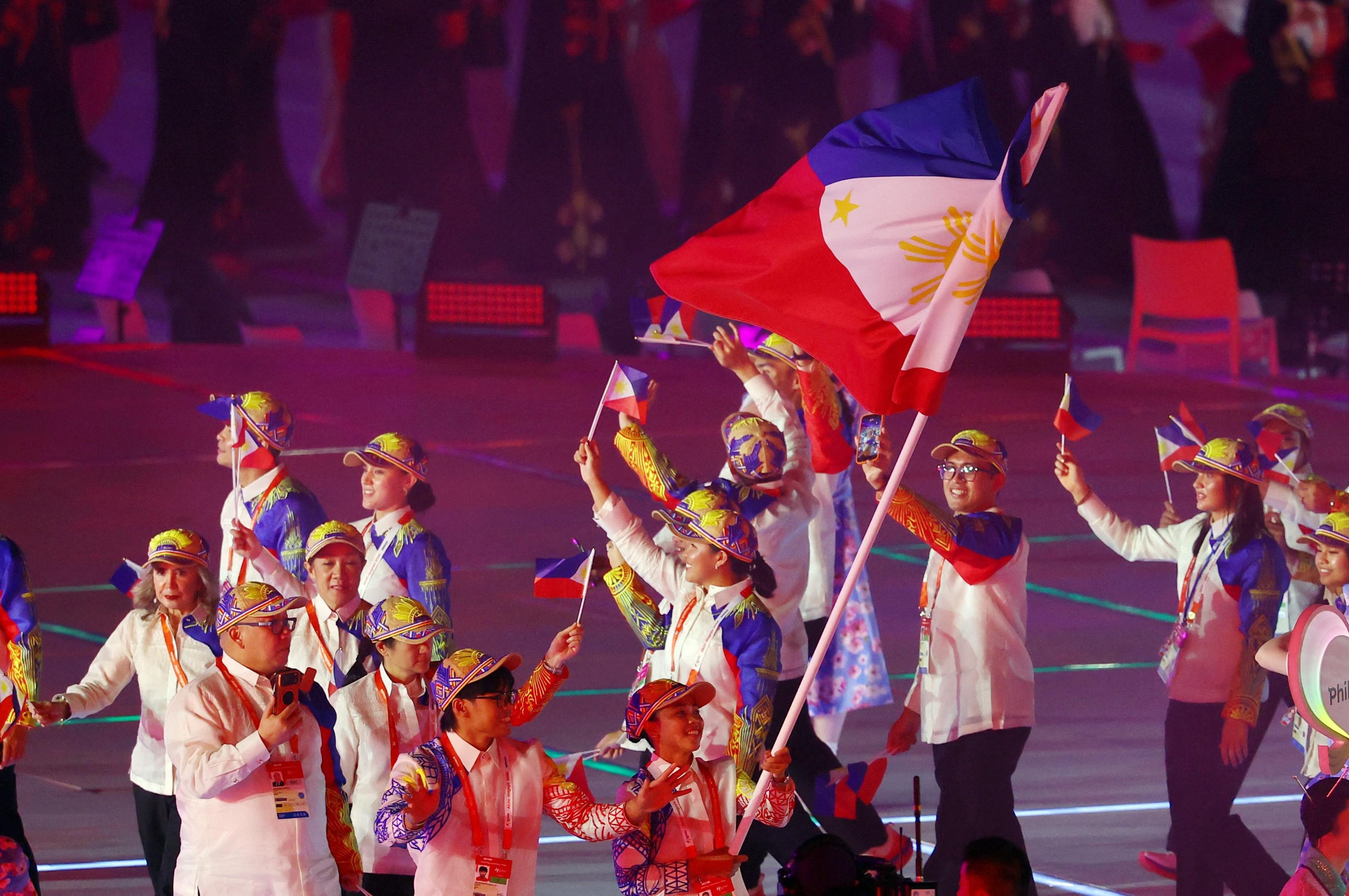
Team Philippines’ opening ceremony uniform generated its own wave of coverage, separate from anything happening on the field. Designer Francis Libiran built “Malaya” around a piña jusi barong, incorporating Baybayin script on one sleeve and Kalinga-inspired patterns rendered in Philippine flag colors, paired with a woven-paper cap and custom sneakers echoing the same design language. Philippine Olympic Committee president Abraham “Bambol” Tolentino called it the best parade uniform in the field: “I feel like it really represents us.”


Following This Campaign
The Philippines sent its largest Asian Games delegation in three decades — more than 450 athletes across 38 sports — under chef de mission Richard Lim. This piece tracked the campaign through the October 4 closing ceremony. Each of its four golds has its own coverage: Carlos Yulo’s floor exercise and vault titles, EJ Obiena’s pole vault defense and Jeus Yape’s taekwondo gold.
Pingback: Carlos Yulo Wins 2026 Asian Games Floor Exercise Gold — the One Title His Collection Was Missing | ELYSPLANET
Pingback: Carlos Yulo Wins 2026 Asian Games Vault Gold, by the Same 0.066 Points, Four Days After Falling in Qualifying | ELYSPLANET
Pingback: Jeus Yape Ends the Philippines’ 40-Year Wait for an Asian Games Taekwondo Gold | ELYSPLANET