
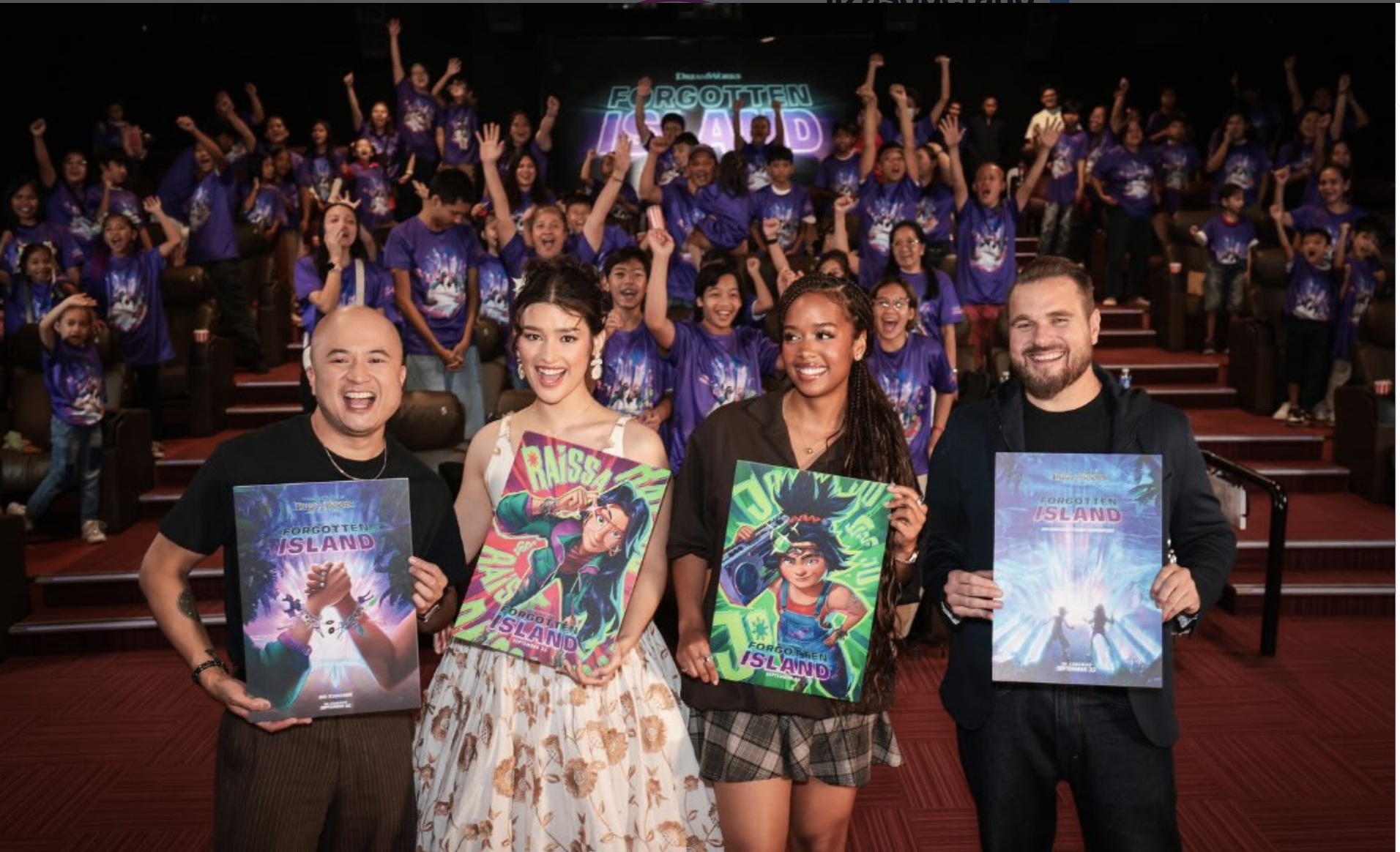
When the cast and creators of DreamWorks Animation’s Forgotten Island arrived in Manila on August 25, the promotional stop carried a different charge from the usual Hollywood press tour. Liza Soberano and Grammy and Academy Award-winning musician H.E.R. joined writer-directors Joel Crawford and Januel Mercado for the Philippine leg of the film’s “Tayo Na!” tour, a homecoming built around the Filipino culture, folklore, music, and family stories that shape the animated feature. For a Hollywood production, the symbolism was unusually direct: this was not simply another international publicity stop, but a return to the cultural landscape that inspired the film.
The stakes surrounding Forgotten Island are exceptionally high. Scheduled for a local theatrical premiere on September 23, 2026 in the Philippines ahead of its September 25, 2026 global release, the animated feature, made on a reported $80 million budget, marks the first time a major Hollywood studio has built a flagship tentpole entirely around Philippine mythology, native dialogue, and the nuanced emotional geometry of the Filipino diaspora.
The Geometry of Loss in 1990s Manila
Set against the backdrop of 1990s Philippines, Forgotten Island bypasses generic fairytale tropes to target a distinctly local heartbreak. High school best friends Jo (H.E.R.) and Raissa (Soberano) are standing on the edge of adult divergence. Raissa’s family is preparing her for relocation to the United States for college—a narrative beat intimately familiar to millions of domestic families who have watched economic necessity fracture personal ties across generations.
Before the two can process their impending separation, a mysterious portal transports them into Nakali, a fantastical realm populated by figures straight out of Philippine folklore. But Nakali is not an innocent fairytale paradise. Its central mechanism is sinister: the island slowly feeds on the memories of anyone trapped within its borders. To escape, Jo and Raissa must navigate a landscape crawling with mythical entities before the island permanently erases the memory of their friendship.
The creative architecture relies on a star-studded voice ensemble that reads like a roll call of global Filipino talent. Broadway legend Maria Lea Carmen “Lea” Salonga lends her voice to the Dreaded Manananggal, while actor Manny Jacinto plays Bungi, a sharp-toothed tiyanak. Actor Dave Franco voices Raww, a well-meaning but hapless aspin weredog who joins the central pair on their journey. Supporting turns from BAFTA nominee Dolly de Leon, comedian Jo Koy, Ronny Chieng, and Jenny Slate round out the voice cast.
Visually, Crawford and Mercado—the creative duo behind the critically acclaimed Puss in Boots: The Last Wish—maintain their signature painterly hybrid animation style. Yet for Forgotten Island, they introduced periodic 2D anime-style sequences during memory flashbacks. These sequences were animated directly by Manila-based animation studio Snipple Animation, serving as a direct visual tribute to the 1990s afternoon anime broadcasts—such as Sailor Moon and Dragon Ball Z—that defined the childhoods of an entire generation of Philippine viewers.

Leaving the Tagalog Untranslated
The most radical decision behind Forgotten Island is not its budget, but its linguistic refusal. In an industry notorious for flattening foreign cultural markers to appease Western focus groups, Mercado fought to keep original, untranslated Tagalog dialogue throughout the primary script.
Speaking during the Taguig media Q&A on August 25, 2026, Mercado explained that retaining native phrasing was non-negotiable for preserving the emotional weight of the narrative. “It is another level of authenticity and giving voice to our characters,” Mercado noted, emphasizing that native phrasing carries a specific cadence and warmth that standard English translations fail to capture.
For Soberano, whose own career pivot from mainstream Kapamilya stardom to international projects has been scrutinized at every turn, the film represents an undeniable artistic victory. Visibly moved during the press session, Soberano highlighted the broader industry implications of having global studios trust Filipino creators with multi-million-dollar budgets. “This feels like the beginning of something big for Filipino creatives around the world,” Soberano shared. She pointed out that while Filipino artists have long contributed to major international animation studios behind the scenes, their names rarely made the top billings or directorial chairs.

The Diaspora Demand and Box-Office Reality
Beyond its artistic ambitions, Forgotten Island arrives at a precarious moment for theatrical exhibition. As local audiences re-evaluate how and when they spend money on cinema tickets, a heavy animated feature must prove it offers something television screens cannot replicate.
Soberano addressed this commercial reality directly, challenging the global diaspora community to show up for cultural cinema with the same unified force typically reserved for international sporting events or global beauty pageants. In the Philippines, collective mobilization is a familiar reflex—whether rallying behind tennis prodigy Alex Eala on the international circuit or cheering on delegates like Asia Rose Simpson at Miss World 2026. Soberano argues that cinema demands the same fierce national alignment. “I really feel like this is going to be a big moment for the Filipino people,” Soberano remarked, calling on audiences across North America, Europe, and the Middle East to convert digital pride into physical ticket sales.
Her call to action directly interrogates modern conversations surrounding what it truly means to be Filipino in an increasingly globalized media landscape. For decades, international representation was defined by isolated individual triumphs—a singer winning a West End role, a beauty queen securing a crown, or an athlete claiming a medal. Forgotten Island shifts the narrative from individual survival to collective infrastructure, asking whether global audiences are ready to embrace Philippine mythology not as an exotic curiosity, but as a universal canvas for human emotion.


Memory as Currency
The ultimate power of Forgotten Island lies in how closely its narrative premise mirrors its real-world cultural stakes. In Nakali, forgotten memories cause individuals to lose their identity. In global cinema, erased histories and softened cultural markers have long threatened to do the exact same thing to entire communities.
By centering an $80-million DreamWorks feature on the fear of forgetting where you came from, Mercado and Crawford have constructed a film that operates on two distinct levels. On screen, two teenagers fight mythical beasts to hold onto their childhood bond. Off screen, a global cast of Filipino artists is forcing Hollywood to remember that our stories were never niche to begin with. When the lights dim in Manila theaters on September 23, 2026, it won’t just be an animated movie opening—it will be a definitive test case for how loud a culture can speak when it refuses to translate itself.
Production Callout
- Title: Forgotten Island
- Production Studio / Distributor: DreamWorks Animation / Universal Pictures
- Directors: Joel Crawford, Januel Mercado
- Lead Voice Cast: Hope Elizabeth “Liza” Soberano (Raissa), Gabriella Sarmiento “H.E.R.” Wilson (Jo)
- Supporting Voice Cast: Dave Franco (Raww), Maria Lea Carmen “Lea” Salonga (The Dreaded Manananggal), Manny Jacinto (Bungi), Dolly de Leon, Jo Koy, Jenny Slate, Ronny Chieng
- Release Dates: September 23, 2026 (Philippines) | September 25, 2026 (Global)
Pingback: How Liza Soberano Secured a Venice Jury Seat | ELYSPLANET
Pingback: Janine Accepts Lifetime Achievement Awards for Nora, Pilita at MIFF Los Angeles | ELYSPLANET
Pingback: Lea Salonga Is the First Filipina to Have a Hollywood Walk of Fame Star. Now, People Can Step on Her. | ELYSPLANET
Pingback: Forgotten Island Debuted at 100% on Rotten Tomatoes — Right Before Its Philippine Homecoming | ELYSPLANET
Pingback: Forgotten Island Box Office: A $12.8 Million Opening and an “A” CinemaScore | ELYSPLANET