
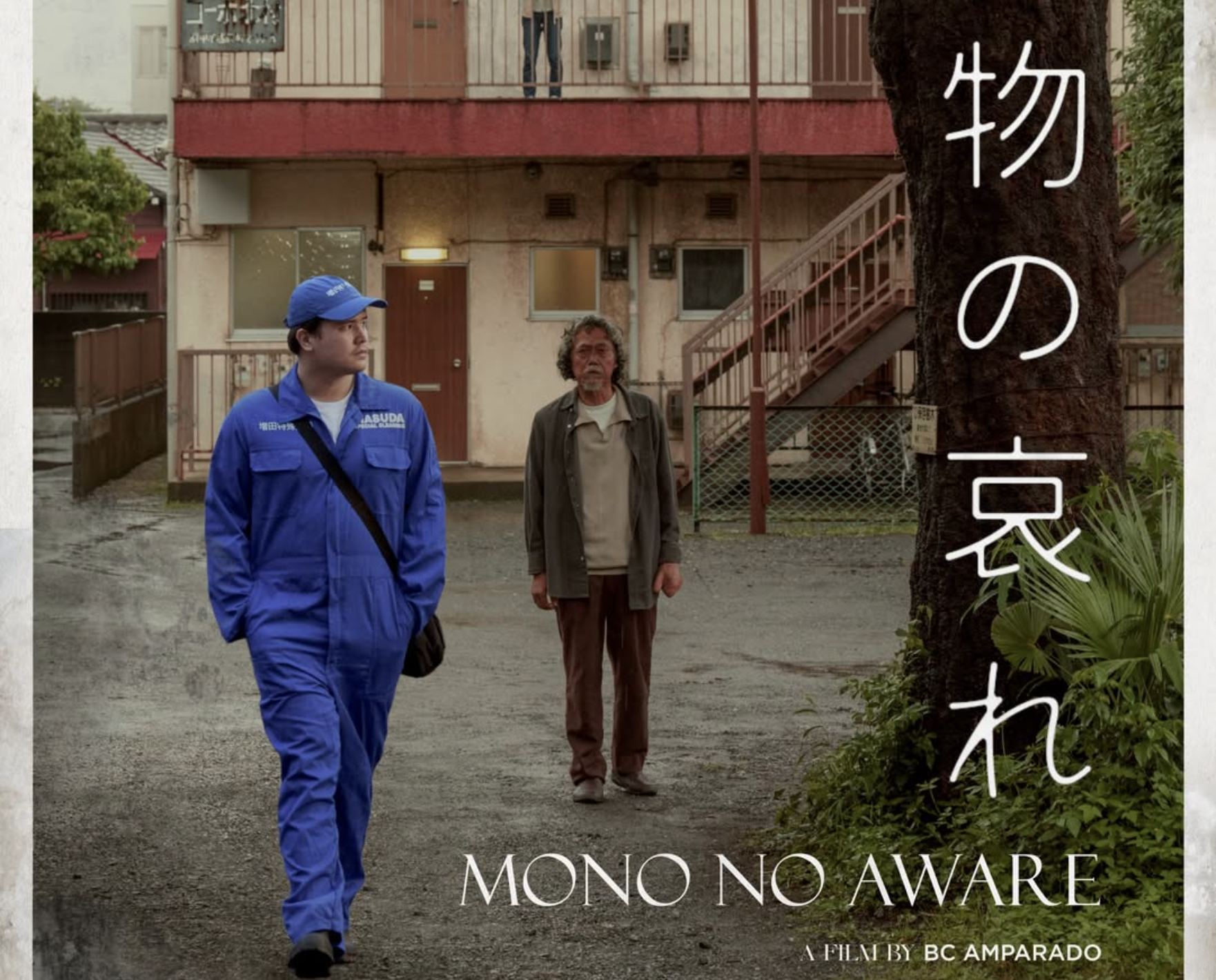
A Filipino kodokushi cleaner in Japan is the film’s premise; the musician-turned-actor at its center, and the crew behind him, are the reason to watch.
In Japan, a kodokushi is a solitary death — someone who dies alone and goes unfound for days, sometimes longer, discovered only once neighbors notice the smell or the unopened mail. It’s become common enough in an aging, increasingly isolated Japan, where more people live alone than at any point in the country’s history, that cleaning up afterward is its own line of work, handled by specialized crews rather than family. That job, done by a Filipino migrant worker, is the setup for “Mono No Aware,” one of seven features competing at this year’s Puregold CinePanalo Film Festival, the supermarket chain’s annual production-grant program that funds each of its seven finalists with ₱5 million toward an original Filipino film.
The title borrows a different Japanese concept — a gentle, wistful awareness of how impermanent everything is — which tracks: the film follows Ichi, a Filipino kodokushi cleaner, who’s asked by an elderly widower for one last favor before he, too, dies. It’s a premise that puts an overseas Filipino worker’s job — usually the kind of labor Philippine cinema treats as backdrop, if it shows up at all — at the actual emotional center of the story, rather than as texture around a more conventional plot.
A Singer Taking On His First Real Lead
Ichi is played by Juan Karlos Labajo, better known in the Philippines as the founder and frontman of the rock band Juan Karlos, whose 2018 breakout single “Buwan” went on to win Song of the Year at multiple local award ceremonies. His screen résumé so far has mostly been supporting work — a Gawad Urian-nominated turn in “Blue Room,” a role as Benigno Aquino Jr. in “Ako si Ninoy,” a part in “Lolo and the Kid” — which makes a lead role built around grief and mortality a real creative stretch for a musician better known for his music than his screen work. He’s also one of the film’s producers, which puts him on both sides of the camera on this one.
Perry Dizon, a veteran of Philippine independent film, rounds out the Filipino side of the cast, alongside a Japanese ensemble that includes Momoko Kobayashi, Paolo O’Hara, Kentarou Furuyama, Aika Higashimori, Kaname Nagamori, and Tadashi Watanabe — a genuinely mixed cast and, per the film’s own listing, mixed spoken languages, rather than a Philippine production simply shooting on location and subtitling around it.

The Pedigree Behind the Camera
Written and directed by BC Amparado, “Mono No Aware” also carries a notable crew credit: production designer Remton Siega Zuasola is a filmmaker in his own right, with a Cinema One Originals entry and a Cinemalaya history behind him, plus a past Berlinale Talents selection — Berlin’s own international talent lab for emerging film professionals. It’s the kind of below-the-line credit that says more about a film’s ambitions than a press release usually bothers to spell out, and it puts an established director’s eye on how a story about death and isolation actually looks on screen, rather than leaving that entirely to a first-time crew.
Still the Quietest Entry in the Field
As of this week, “Mono No Aware” hasn’t had the kind of dedicated feature or sit-down interview that several of its fellow CinePanalo entries have already gotten — what’s public so far is a poster, a logline, and a confirmed cast and crew list. That may change before the festival opens; for now, the film’s case rests on its premise and its people rather than a quote-driven profile.
Philippine cinema already has a long tradition of stories about Filipinos working abroad, usually built around the ache of distance from family back home. “Mono No Aware” is working a narrower, stranger corner of that same territory — an overseas Filipino worker whose entire job is standing in for the family that isn’t there when a stranger dies alone, before turning around and doing the same, in a smaller way, for one man who’s still alive to ask for it.
Puregold CinePanalo 2026 runs September 23 through October 4 across eight Metro Manila venues: Gateway Cineplex 18 Araneta (the festival hub, with exclusive Panorama Shorts screenings), TriNoma, Fairview Terraces, and Ayala Malls Feliz, Circuit, and Manila Bay, plus Market! Market! Tickets are ₱250 regular and ₱200 discounted (PWD, senior, student, national athlete, and Aling Puring & Perks cardholders). The ₱2,000 all-access festival pass, covering all seven features plus the student shorts program, goes on sale a day early — September 22 at Gateway Cineplex 18 specifically — ahead of the general September 23 on-sale at the other seven venues.
Pingback: Puregold CinePanalo 2026 Is Finally Showing What Its ₱5 Million Gamble Bought | ELYSPLANET
Pingback: CinePanalo 2026 Winners: Mono No Aware Wins Nine Awards, Including Best Picture | ELYSPLANET
Pingback: Japanese Film Festival 2026: Free Screenings in Six Cities, With SM Manila Running October 16 to 25 | ELYSPLANET