
WHEN A RETAIL giant chooses to announce a film festival by unspooling an oversized grocery receipt, corporate arts patronage can easily curdle into self-parody. The imagery invites an obvious cynical reading: supermarket cashier tape turned into pop art, consumerism repackaged as creative stewardship. Yet when Puregold CinePanalo rolled out that giant receipt in October 2025, the numbers stamped across it were not promotional discounts. They were actual production budgets: ₱5 million for each of the seven full-length films selected for its 2026 cycle.
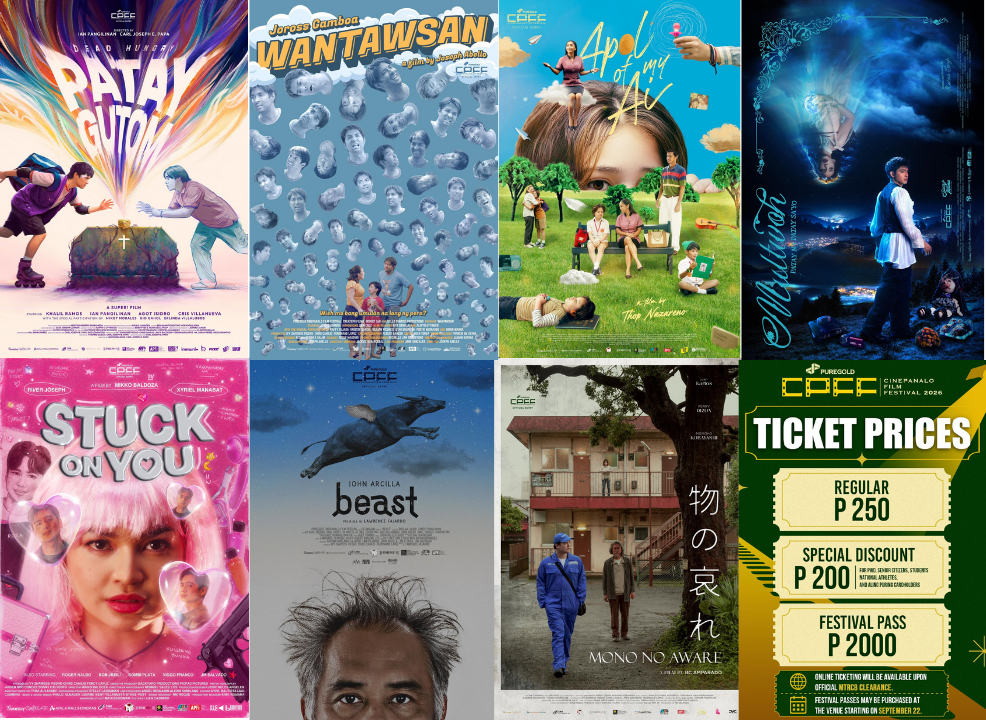
Almost a year later, those numbers have finally materialized on screen. On August 27, the festival released the official posters for its feature entries, followed twenty-four hours later by the selection of ten completed works for its new Panorama Shorts program. With the festival’s twelve-day theatrical run beginning September 23, 2026, the conversation around Puregold’s record-breaking grant model is moving from what the company promised to what filmmakers actually made with the money. The question now is what happens when creators are given substantial financial leverage without being asked to fit their stories into a predetermined corporate template.

Capital as Creative Oxygen
In Philippine independent film, budget is rarely just a financial metric; it is an aesthetic constraint. The historic gap between what a director writes on a legal pad and what eventually lands on a cinema screen can be measured in lost shooting days, exhausted crews, and compromised post-production. Independent filmmakers routinely have to make production decisions around whatever can be borrowed, stretched, or postponed. A ₱5 million production grant does not guarantee artistic brilliance, but it fundamentally alters the starting conditions under which a film is made.
It gives directors more room to pay crews properly, secure experienced performers, allow for additional takes, and invest in color grading and sound design. Alongside the cash grants, technical infrastructure has expanded to match. Equipment supplier CMB Film Services increased its rental grants to ₱1.25 million per feature project, supported by a technical partner network that includes Canon Marketing Philippines, Terminal Six Post, IM Rentals, Stage Post Audio, the Asia Pacific Film Institute, the Film Development Council of the Philippines, and the MTRCB. The additional technical support also reduces one of the practical constraints that can force independent productions to compromise on equipment and production quality.
The significance of the arrangement is therefore larger than the ₱5 million printed on each imaginary receipt. Production money and equipment support address two of the most persistent practical pressures facing independent productions at the same time, giving the selected directors more room between the film they proposed and the film they eventually deliver.

Breaking the House Style
What makes the 2026 cycle an editorial departure from past CinePanalo editions is Puregold’s deliberate removal of its previous thematic restrictions. Earlier editions operated within more defined thematic territory, giving filmmakers a particular framework through which their projects had to be conceived. For 2026, those boundaries were removed, opening the competition to different genres, topics, and approaches and leaving filmmakers considerably more freedom to determine what kind of film they wanted to make.
That creative liberty is visible in the final seven, culled from 203 original submissions through successive rounds that reduced the field to 70, then 33, then 15 before the final selection. The slate spans Joseph Abello’s Wantawsan, BC Amparado’s Mono No Aware, Thop Nazareno’s Apol of My Ai, Lawrence Fajardo’s Beast, Mikko Baldoza’s Stuck on You, Rodina Singh’s Multwoh (Patay na Patay Sa’yo), and the collaborative Patay Gutom (Dead Hungry) from animation filmmaker Carl Joseph Papa and Ian Pangilinan.
The range is significant precisely because the seven films do not share a prescribed CinePanalo sensibility. Established filmmakers sit alongside distinct emerging voices, while the projects move across different narrative and visual territory. The festival’s role is less about prescribing the destination than selecting which filmmakers it is willing to back for the journey.


The Student Pipeline and the Films Beyond It
The structural architecture of CinePanalo extends beyond the headline features. Running alongside the main competition is a student short program that awarded ₱200,000 grants to 20 campus filmmakers selected from 267 submissions. For university filmmakers working with limited production resources, that amount can be the difference between a thesis film assembled around whatever can be borrowed and one produced with an actual working budget. It also introduces young directors to the practical demands of production: managing a budget, securing equipment, dealing with locations and permits, coordinating a crew, and delivering a finished film within a defined schedule.
Then comes Panorama Shorts, the new section announced this week. While CinePanalo’s primary engine builds films from the ground up, Panorama gives ten already-completed Filipino short films a dedicated theatrical platform at Gateway Cineplex 18, including a film by award-winning filmmaker Zig Dulay. The section addresses a different problem in local cinema: what happens after an independent filmmaker has finished the movie but still has no obvious Philippine theatrical home for it.
That problem is particularly familiar with short films, which can accumulate festival screenings and international recognition while remaining largely invisible to the domestic moviegoing public. In an ecosystem where independent work can end up circulating through unauthorized digital distribution simply because audiences have no legitimate way to see it, giving completed shorts a commercial cinema platform addresses another weak point in the local film ecosystem.


The Geography of Commercial Exhibition
For a festival built around independent cinema, its physical footprint matters almost as much as its programming. Too often, Philippine independent films remain concentrated in academic auditoriums, specialist cultural venues, or a handful of festival locations, requiring audiences to actively seek them out. CinePanalo’s 2026 exhibition strategy takes the films into major commercial multiplexes instead.
Running from September 23 through October 4, the festival establishes its flagship venue at Gateway Cineplex 18 in Araneta City, Quezon City, which will also serve as the exclusive home of Panorama Shorts. The seven full-length films and 20 student shorts will also screen at six Ayala Malls cinemas: TriNoma and Fairview Terraces in Quezon City, Ayala Malls Feliz in Pasig, Ayala Malls Circuit in Makati, Ayala Malls Manila Bay in Parañaque, and Market! Market! in Taguig.
Individual tickets are priced at ₱250, with ₱200 admission available to eligible students, seniors, PWDs, and Aling Puring members. A full-festival pass is priced at ₱2,000, with festival pass sales beginning September 22 at Gateway Cineplex 18. The pricing and venue strategy put these films in the same commercial environment where audiences ordinarily choose between Hollywood releases, mainstream Filipino titles, and everything else competing for their weekend movie money.
For independent cinema, that is not a minor logistical detail. Financing a film and finding an audience are separate problems, and solving the first does not automatically solve the second. CinePanalo is now putting its films in places where audiences do not have to already identify as independent-film devotees before deciding to buy a ticket.
The Grocery Receipt, Revisited
There remains an unusual collision at the center of CinePanalo: a supermarket company financing filmmakers whose work may have little connection to the commercial world that pays for it. The giant grocery receipt that introduced the seven projects made that contradiction visible from the beginning, but the 2026 program has made the metaphor more complicated. Puregold’s involvement now stretches across production grants, equipment support, student filmmaking, completed independent shorts, and theatrical exhibition.
Corporate sponsorship of the arts is hardly new. What is unusual here is the degree to which the company has moved into the production pipeline itself, accepting the uncertainty that comes with funding films before audiences, critics, or distributors have decided whether those films will matter. Earlier CinePanalo projects have already reached international festivals, giving the program a track record that extends beyond its own awards ceremonies and premieres. The 2026 cycle now broadens that experiment with a larger feature grant, a stronger technical support system, a student pipeline, an exhibition platform for completed shorts, and a wider commercial cinema footprint.
In October 2025, the giant receipt was a promise of capital. By September 23, 2026, as posters fill mall corridors and screening schedules lock into place, the paper artifact will have been replaced by something much harder to manufacture: twelve days of Filipino films competing for local audiences who have paid to see them. CinePanalo has spent the past year putting money, equipment, and institutional support behind filmmakers who might otherwise have struggled to get these projects off the page. Now the films have to do their part. The audience gets the final say.
Pingback: VR Relosa: Before the Vivamax King, There Was the Boy Who Slept at McDonald’s | ELYSPLANET
Pingback: ‘Beast’ at CinePanalo 2026: John Arcilla’s First Film Since His Venice Win Comes With a Singing Carabao | ELYSPLANET
Pingback: CinePanalo 2026’s ‘Stuck on You’: When a Heartbroken Manicurist Becomes an Accidental Hitwoman | ELYSPLANET
Pingback: ‘Patay Gutom’ at CinePanalo 2026: A Ghost Story, a Directorial Debut, and a BL Crossover Years in the Making | ELYSPLANET