
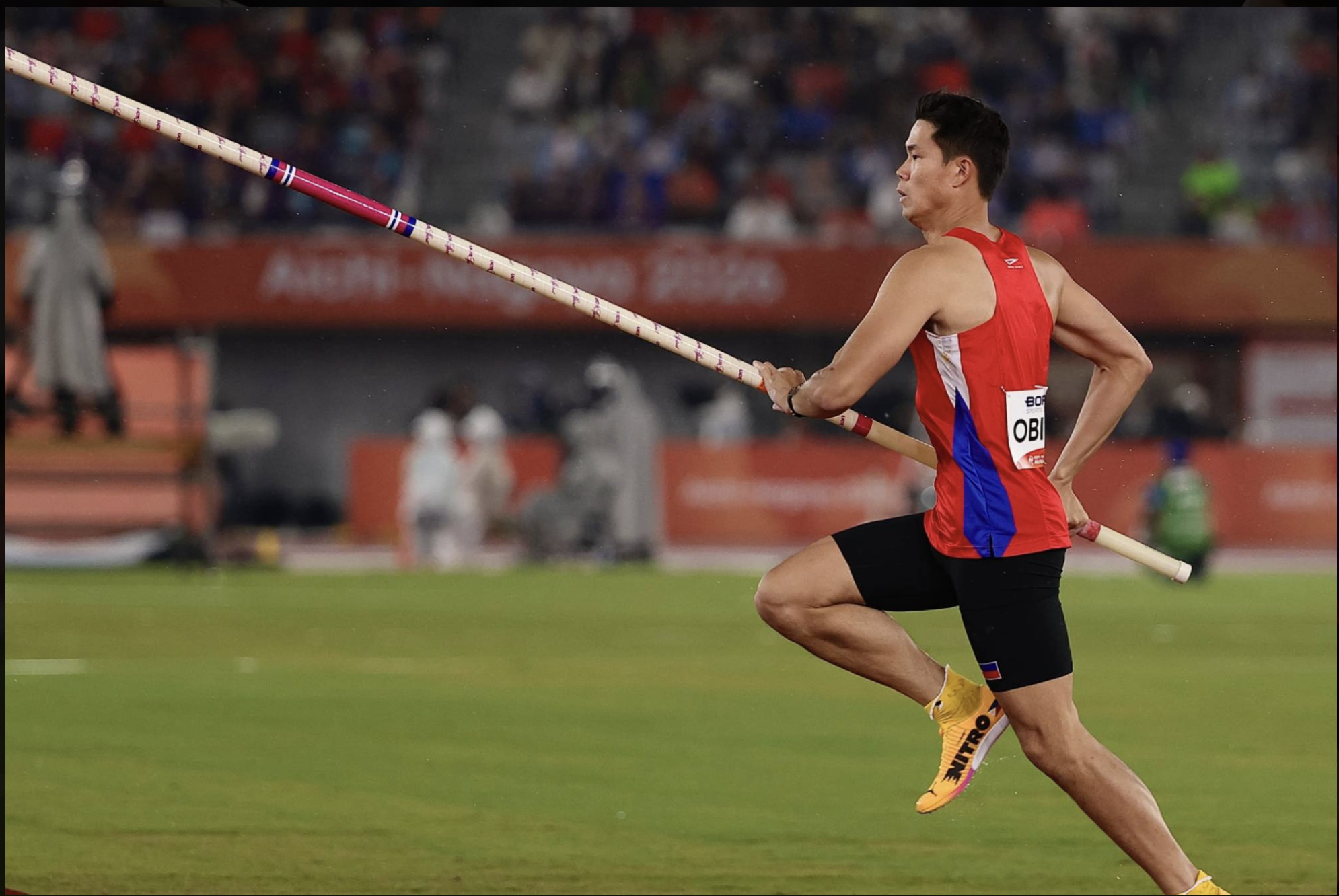
By the time EJ Obiena asked for the bar to go up to 5.91 meters on Tuesday night in Nagoya, the result was already settled. China’s Li Chenyang had run out of attempts at 5.80, and the Asian Games pole vault title belonged to Obiena for the second straight edition. The last jump was optional. He took it anyway. On his final attempt he cleared 5.91m, erasing the 5.90m Games record he had set himself in Hangzhou three years earlier.
It was the Philippines’ third gold of the 20th Asian Games in Aichi-Nagoya, after Carlos Yulo’s floor and vault titles. It was also the first gold for the country’s athletics team at these Games. Obiena, who holds the Asian record at 6.00 meters, became the first Filipino track-and-field athlete to retain an Asian Games title since sprinter Lydia de Vega in 1986.
How the Gold Was Settled Before the Record
In pole vault, each athlete gets three tries at a height. An athlete can also “pass,” skipping a height and saving attempts for the next one. That makes the late rounds a test of nerve as much as a test of jumping. Obiena came in as the highest-ranked vaulter in the 12-man field and played it safe. He skipped the opening heights and cleared 5.50m on his first try. He passed 5.60m, then cleared 5.70m and 5.75m, each on his first attempt. China’s Yao Jie failed all three tries at 5.75m.
The only man willing to gamble was Yao’s teammate. Li, ranked No. 20 in the world to Obiena’s No. 11, passed on 5.75m and went straight to 5.80m to challenge him. He missed twice there, then used up his remaining attempts, which handed Obiena the gold.
The night followed the Hangzhou script closely. In 2023, clearing 5.75m also secured the gold, and Obiena raised the bar to 5.90m afterward for the record. Both times, 5.75 won him the title and the record came after the field had emptied.
A Season Built for This Jump
The record matters more because of how Obiena reached Nagoya. According to Manila Bulletin, 2025 was a difficult year in which he slid from as high as world No. 2 to No. 16. He now trains in Athens under Polish coach Marcin Szczepanski and works with physiotherapist Christian Ferdinandi.
The 2026 season shows the rebuild worked. Between January 24 and September 1 he competed in 26 meets, winning nine and reaching the podium 14 times. His season best of 5.91m came at the Golden Sand meet in Poland on August 17. That clearance in Międzyzdroje, a 5.90m jump in Zürich, and a 5.82m win in Berlin all came within two weeks. ElysPlanet covered that Berlin win when it happened. So the Nagoya record didn’t go beyond anything he had done this season. It matched his best, and it came at the end of a long season in the meet where it counted most.
He sounded like he knew it before the final. He told BusinessMirror he expected a tougher Asian Games than the last one, but said, “I am capable of winning it.”
Pressure, Again
The 2023 record had come with a lot of pressure. Looking back on Hangzhou, Obiena said that was where he truly embraced the phrase “pressure is privilege.” In the same interview before these Games, he said he didn’t want to relive past achievements, including that 5.90m jump, and would rather create new moments. His last jump on Tuesday did exactly that. He didn’t need it for the medal and asked for it anyway.
His career hasn’t always had the backing it has now. In 2022, the Philippine Athletics Track and Field Association (PATAFA), the sport’s national federation, recommended expelling him from the national team and filing a criminal complaint over his coach’s salary. That dispute ended only after a fifth round of mediation led by the Philippine Sports Commission. Four years later, he has defended an Asian Games title with a record.
What It Means for the Medal Table
The Philippines came to Nagoya targeting eight golds and now has three, and both gold medalists are done competing. The Asiad is expected to be Obiena’s last meet of the season. Before Tuesday’s final, the delegation needed two more golds to match its Hangzhou total of four. Obiena’s gold means one more would equal it. Carlo Paalam in boxing and Alex Eala in tennis are the most likely sources. The full tally, updated as results come in, is in our running medal hub.
Pingback: The Philippines Wants 8 Golds at the 2026 Asian Games. Yulo and Obiena Have Delivered Three. | ELYSPLANET