
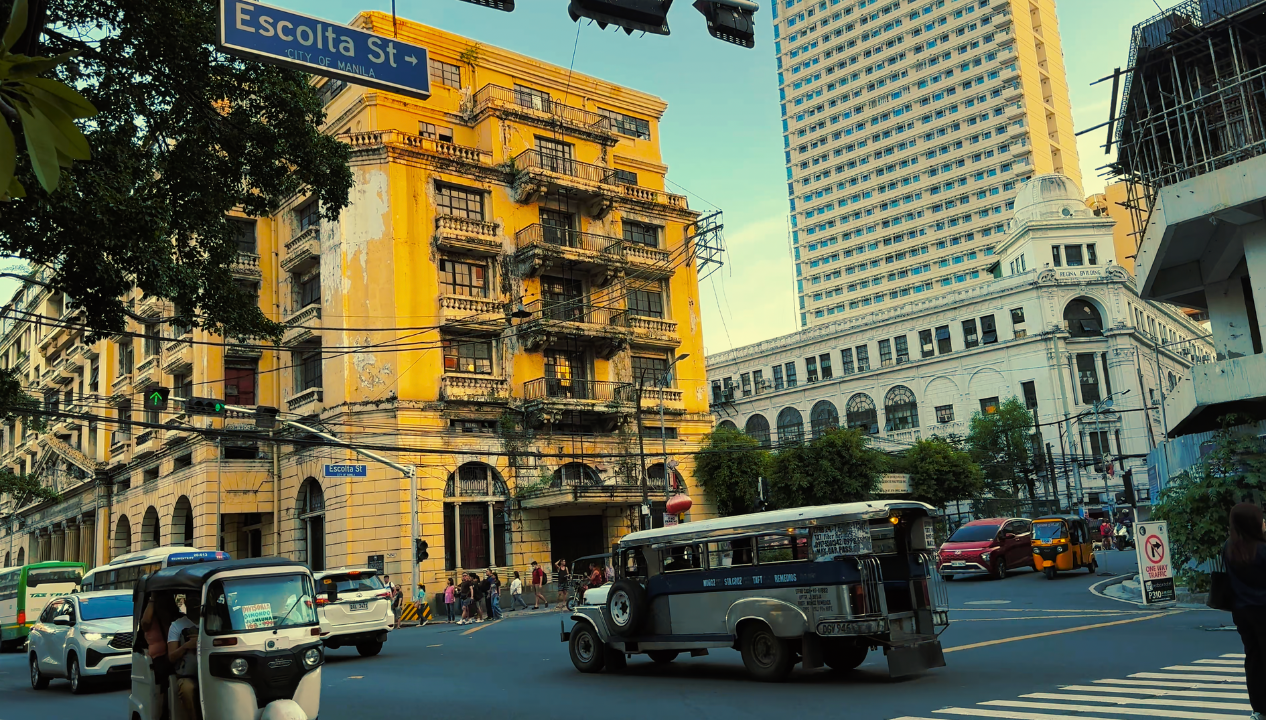
The heat hits you first. Diesel smoke, damp concrete, and the low, heavy hum of a city moving too fast. Step off the LRT-1 — the Light Rail Transit Line 1, the elevated train that’s been cutting through this part of Manila since the 1980s — at Carriedo, and the crowd swallows you whole. This line alone moves several hundred thousand riders across the city every day, and a good chunk of them funnel through this exact station on their way to Quiapo, Divisoria, or Chinatown, none of them looking up at the old buildings, all of them chasing a clock. This used to be where the money lived. Decades ago, this stretch wasn’t just prosperous — it was the financial heart of the Philippines, nicknamed “the Wall Street of the Philippines” back when the Philippine National Bank ran its very first headquarters out of the Masonic Temple a few blocks down. But capital is restless, and the banks eventually packed up their vaults for the air-conditioned towers of Makati and BGC, leaving these blocks to survive on twelve-hour shifts and quick cash sales. There’s no room for architectural nostalgia when you’re trying to pay for dinner tonight.


Walk two minutes west, past Plaza Lacson, and the roar breaks into an eerie, heavy silence. Welcome to Escolta.
The Guard Who Watches Nothing
The real decay here shows up in the quiet exhaustion of the people paid to watch these buildings fall, more than in the cracked walls or the peeling neoclassical columns themselves. Beside one pre-war entrance, tucked into a weathered plastic chair, a security guard sat adjusting a manual logbook on his lap, his face deeply lined, never once looking up. His faded blue uniform looked like it had been through years of this — long enough, it seemed, to remember when these buildings still had tenants worth guarding.
His presence tells you the math plainly. Retrofitting a century-old building to survive an earthquake, under Manila’s current structural codes, costs more than the land beneath it is worth on paper. So owners play a waiting game: let the rain do the demolition for free, pay a guard a basic wage to keep squatters and scrappers out, and hold on until the walls collapse enough to justify tearing the rest down for a parking lot or a mid-rise. What he’s actually protecting is an asset in limbo, held together by paperwork and patience while gravity finishes what the developers legally can’t start — heritage has little to do with it. Cash flow drives the calculation, and when space gets this tight and land this expensive, beauty stops being something these streets can afford. To a landlord looking at a balance sheet, an old building has always been a problem waiting on the weather to finish it off.

The Gated Oasis
Still, human intent has a funny way of defying cold math, and a few doors on Escolta stay unlocked in spite of it. The First United Building — an Art Deco survivor from the 1920s that refused to go down quietly, one of a handful on this street (alongside the Regina Building and the Beaux-Arts Calvo Building, which now houses a small museum of pre-war Escolta photographs) that somehow made it through both the war and the decades of neglect after — houses HUB Make Lab, a collective of young artists, vintage collectors, and independent local brands. Inside, you won’t find corporate offices or air-conditioned lobbies, just old buildings getting new life without a safety net: no government grants, no corporate handouts, young locals carving out a sanctuary inside the ruins one stall at a time. Instead of tearing down the cracked walls, they built partitions inside them, hung string lights from exposed beams, and turned a dying office floor into something closer to a permanent flea market. But keeping the lights on without big investors behind you is a daily grind — every small stall here is fighting to prove that local culture can actually cover the monthly rent, one antique typewriter or hand-printed tote bag at a time.
If you want to know what saving history really costs, look at the small businesses keeping the doors open downstairs. At The Den Coffee, watch a barista weigh out local beans, one pour-over at a time, in a room that still has the building’s original tile floor underfoot. In a city dominated by giant corporate chains that can absorb a bad month, running a small specialty shop on Escolta is an act of defiance — there’s no headquarters cushioning the rent if a slow week turns into a slow quarter, and no venture capital coming to bail it out either. Heritage requires direct support, not sentiment, which means the ₱180 you spend on a pour-over here is doing double duty: it’s caffeine, and it’s a small, literal contribution to keeping a roof from falling in. When institutions walk away from history the way the banks walked away from Escolta, what’s left to save it is exactly this — the loose change in people’s pockets, spent fifty and a hundred pesos at a time on the version of this street worth keeping around.

The Wall Passion Runs Into
By six in the evening, the metal shutters roll down along Escolta, one after another, like a countdown. The lights at HUB go dark, The Den closes its register, and the street returns to the shadows — and that’s the wall local creative efforts run into every single night. Creativity is a strong start, but it can’t fight a 24-hour economy on daytime office hours alone. Down in BGC, the glass towers glow all night, fueled by international companies and call centers that never sleep, pulling in the kind of rent Escolta hasn’t seen since before the war. Escolta can’t win that race on weekend markets and a handful of specialty cafés, no matter how good the coffee is — not when the loose change holding this street together is competing with a district that never has to close.

Walk to the end of the street and you find one, or at least the start of one: the Pasig River. If private land has become too expensive for our history to survive on, the city has to find its breathing room somewhere else, somewhere the market can’t price it out of existence. That’s exactly what we go looking for next — a massive public space trying to do what the private market refused to: give the river, and by extension the city itself, back to the people.
Field Notes
Getting there: Ride the LRT-1 (Light Rail Transit Line 1) to Carriedo Station, then walk 2 minutes toward Plaza Lacson to the eastern mouth of Escolta Street. Alternatively, ride the Pasig River Ferry to Escolta Station — direct, traffic-free access from Pasig, Makati, and Mandaluyong.
First United Building (413 Escolta St.): Home to HUB Make Lab, open 11:00 AM–6:00 PM. Vintage goods, local artisan work, and one of the street’s best-preserved Art Deco facades.
The Den Coffee (ground floor, First United Building): Specialty coffee, ₱150–₱220 a cup. Every purchase goes directly toward the building’s upkeep.
Worth knowing: Escolta’s heritage buildings fall under Republic Act No. 10066 (the National Cultural Heritage Act), though enforcement is a separate question from what’s actually keeping these specific structures standing day to day.
Budget (per person, PHP)
- LRT-1 fare to Carriedo: ₱15–30
- Coffee at The Den: ₱150–220
- Browsing/small purchase at HUB Make Lab: ₱200–500, varies by piece
- Total for a couple hours on Escolta: ₱400–750
This is the first stop in a longer thread on what’s happening to public and heritage space in old Manila — next, we cross the bridge to see what happens when the city, not the private market, decides to invest.
Photos and videos by Ely Valendez.
Pingback: The Pasig River Esplanade Is a ₱32 Billion Bet That Free Space Still Matters | ELYSPLANET
Pingback: The Pasig River Ferry Is Free. Almost Nobody’s on It. | ELYSPLANET