
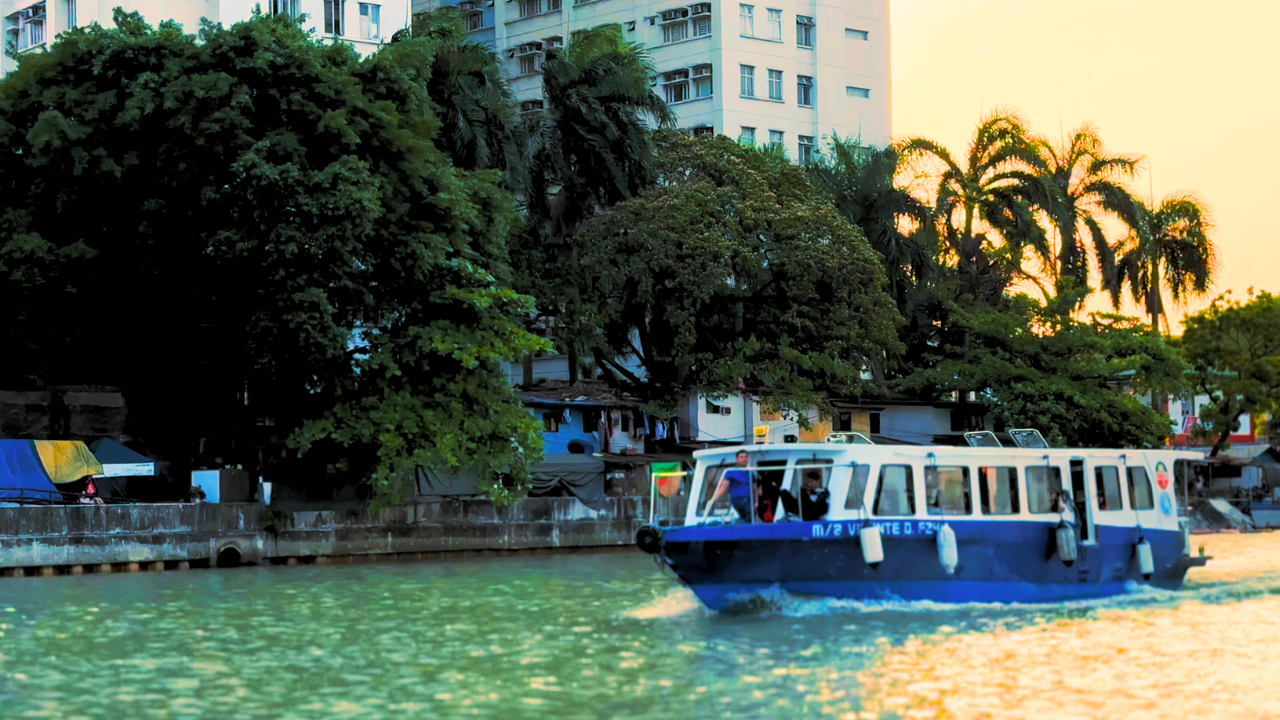
Diesel prices in Metro Manila have spent much of this year climbing, and transport groups have staged more than one strike over it — most recently a two-day stoppage in July, with drivers demanding a fare increase to keep pace with fuel costs. September pushed it further. Three straight weekly hikes, the latest on September 22, added ₱18.31 to every liter of diesel in three weeks and carried the pump price past ₱100 in Metro Manila, while the Palace called a fare increase a last resort. In the middle of all that, there’s a boat that most of the city still treats as a rumor. The Pasig River Ferry runs free, seven days a week minus Sunday, cutting straight through the middle of the same gridlock everyone else is stuck paying for.
I rode it from Guadalupe to Escolta on a weekday morning, and the ride itself is almost anticlimactic — the engine sits at a low, steady drone, the water slaps flat and brown against the hull, and the air smells less like a river and more like diesel and wet concrete, cut every few minutes by a breeze off the water that actually cools you down, which nothing at street level in Manila manages to do in August. The strangest part was how empty the boat was: eleven seats, four of them filled, on a route that runs parallel to some of the worst traffic in the country.
That gap — a free, working piece of transit infrastructure sitting half-used while people walk for hours rather than pay one more peso in jeepney fare — is the actual story here, more than the scenery.
A River That Used to Be the Highway
The Pasig was Manila’s original commuter route, centuries before EDSA — Epifanio de los Santos Avenue, the traffic-choked artery that now defines the city’s rush hour — ever existed. What’s left of that history is a ferry service that still runs the same water, now squeezed between riverside factories built for an era of cheap energy and skylines that barely notice it’s there. Corrugated warehouse roofs lean rust-streaked over the water in places; a few blocks later, glass towers rise directly behind them like the two eras never negotiated a handoff. From the middle of the river, Makati and Ortigas look almost weightless — stripped of their usual haze simply because fewer engines were burning that week, a clarity that shows up whenever the city’s traffic drops, which in Manila mostly happens during a crisis, not by design.
The contrast that’s hard to shake is Bangkok. The Chao Phraya Express Boat feeds directly into the BTS Skytrain — Bangkok’s elevated rail system — at interchange stations like Sapan Taksin, river and rail functioning as one system instead of two competing options. Manila has the river. What it’s missing is the last mile: a ferry stop that actually connects to an MRT platform, a jeepney route, a bike lane, anything. Right now the free boat and the jeepney a commuter can no longer afford to fuel exist as separate, disconnected choices instead of one system a rider can chain together.
The Fight Over What Happens to the River Next
That gap in planning isn’t neutral — there’s an actual proposal on the table that would make it permanent. PAREX, the Pasig River Expressway, is a roughly 19-kilometer elevated tollway that would run six lanes of concrete directly over the water, from Radial Road 10 in Manila to the Southeast Metro Manila Expressway. Heritage groups, urban planners, and environmental scientists have opposed it since it was first proposed in 2021, arguing an elevated deck would block sunlight to the river below and cut off exactly the kind of waterway revival that a ferry-and-rail network would need. San Miguel publicly said it was stepping back from PAREX in 2024 after the pushback — but the project has never actually died. As recently as May 2026, opinion pages were still describing PAREX as a “live” government project, with critics pointing out that no reputable independent planner has come out in support of it besides those on San Miguel’s payroll. An elevated tollway over the Pasig would just stack a second failure directly on top of the first one, in concrete, with a toll gate attached, doing nothing for the last-mile problem underneath it.
Where This Could Actually Go
There’s an actual plan on the table to fix the last-mile gap, and it’s further along than most people realize. The Metropolitan Manila Development Authority (MMDA) — the government agency that oversees metro-wide traffic, transit, and flood control across Manila’s cities — announced in June that it’s adding new stations along the Marikina River corridor: Rosario, Bridgetowne, Eastwood, Riverside. That extends the existing Pasig River Ferry Service north into Marikina and Quezon City rather than leaving it boxed in between Guadalupe and Escolta.
That’s the near-term piece. The bigger one is MAPALLA — the Manila Bay–Pasig River–Laguna Lake Ferry System — a genuinely ambitious plan to link four separate waterways into one commuter network: the Pasig River, the Marikina River, Manila Bay, and Laguna de Bay. Under the latest timeline, the first phase covering the Pasig and Marikina Rivers is slated for construction from 2027 to 2029, running on a fleet of 75 electric vessels, with the Manila Bay and Laguna de Bay segment following years later, targeting 2035. Projected ridership starts modest — around 10,000 passengers a day in year one — but is expected to climb past 30,000 daily as the network fills out.
None of that is built yet, and Philippine infrastructure timelines have a well-earned reputation for slipping. But it’s the first real answer to the Bangkok comparison: a plan that treats the river as a network, not a novelty. Whether it actually gets there by 2029 is the thing worth watching over the next few years — and worth a ride down the Pasig in the meantime, before the current, smaller version of this system is the only one you’ve ever seen.
Why the Ferry Is Still Worth Your Saturday
Setting the politics aside, none of that should scare anyone off actually riding it. The Guadalupe–Escolta stretch is one of the more interesting free things to do in Metro Manila on a weekend morning: quiet, breezy, a genuinely different angle on a skyline you normally only see from underneath it — church spires and cargo cranes trading places with each bend in the river — and a landing point a few minutes’ walk from Binondo and Escolta’s old commercial district if you want to turn it into a longer afternoon. It’s also, at zero pesos, one of the least defensible things in the city to still be skipping — and with fares elsewhere in the city only getting more expensive, that math gets easier to make every month.
Field Notes
Route covered here: Guadalupe (Makati, near MRT-3 Guadalupe Station — Metro Rail Transit Line 3, the elevated line running along EDSA) to Escolta (Manila), downstream. The full network has 13 stations spanning Pasig, Mandaluyong, Makati, and Manila, including Pinagbuhatan, San Joaquin, Maybunga, Kalawaan, Hulo, Lambingan, Santa Ana, PUP, and Lawton/Quinta Market.
Schedule: Monday to Saturday only, no Sunday service. Roughly 7:00 AM to 6:30–7:00 PM depending on the station, with trips at mostly hourly intervals — expect the first Guadalupe departure around 7:00 AM and last around 4:30–5:30 PM going toward Escolta. Service is suspended during Holy Week and on other select holidays — check MMDA channels before you plan around it.
Getting there: Guadalupe station sits a short walk from MRT-3 Guadalupe Station, making it an easy add-on if you’re already near EDSA. Escolta station drops you within walking distance of Binondo’s food strip and the Escolta heritage district — good place to end a ride with coffee.
Amenities: Restrooms, CCTV, and free Wi-Fi at stations.
Budget (per person, PHP)
- Ferry ride: ₱0 (free, all stations, all routes)
- Jeepney/tricycle to Guadalupe station: ₱15–30
- Coffee or merienda around Escolta after landing: ₱100–250
- Total for the ride itself: ₱0, plus whatever you spend getting to and from the water
This closes out a short thread on public and heritage space along the Pasig — read the first two, on Escolta and the Pasig River Esplanade, if you haven’t. We shot the footage behind this piece earlier this year; if you want the visual feel of the ride — the empty boat, the skyline from the water — the video’s still up here.