
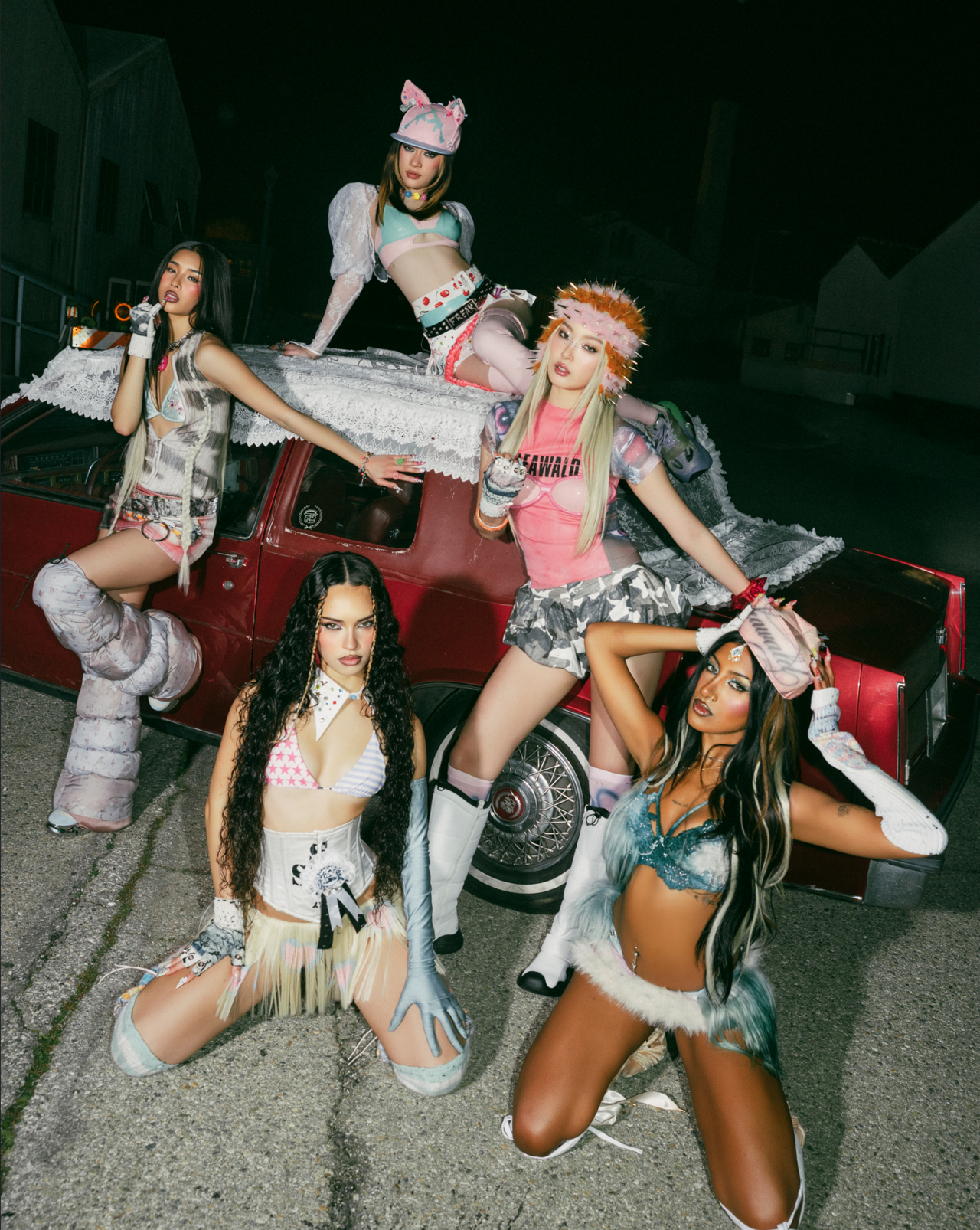
There’s a strange split-screen quality to KATSEYE’s last two weeks. On one side, the HYBE and Geffen Records-backed global girl group — HYBE is the South Korean entertainment company also behind BTS, here partnered with Universal Music Group’s Geffen Records — is rolling out its most confident era yet: a third EP, a documentary, a sold-out world tour, and a public image built around freedom and self-expression. On the other side, two of its six members aren’t part of any of it.
Manon Bannerman has been on hiatus since February. Sophia Laforteza, KATSEYE’s Filipino-American leader, announced her own break on August 7, a day before the group’s headlining set at the Head in the Clouds festival in Pasadena, California. Per the group’s statement, the decision followed consultations with medical professionals who advised extended rest; her status won’t be reassessed until September. The remaining four members — Daniela Avanzini, Lara Raj, Megan Skiendiel, and Yoonchae Jeung — have said they remain in close contact with both women and continue to support their decisions.
Then, on August 16, Sophia was spotted at Disneyland riding Space Mountain with Leon Barretto — the Filipino actor and content creator, younger brother of actress Julia Barretto and content creator Dani Barretto — whose on-again speculated romance with Sophia has followed her since a family trip to Hong Kong Disneyland last January and his public cheerleading at her Coachella debut in April. Philippine entertainment outlets picked it up almost immediately, and social media turned the sighting into relationship forensics, the way it always does with Sophia and Leon.
That’s the easy story, and the smaller one. The more interesting thing happening around KATSEYE right now is what happens when a pop group built to belong to everyone runs into an audience that doesn’t agree on who its members are allowed to be.

A Girl Group With No Hometown
KATSEYE didn’t come up through a local scene or a national star system. It was assembled — deliberately, on camera — through The Debut: Dream Academy, a 2023 reality competition co-created by HYBE and Geffen Records that whittled roughly 120,000 applicants down to a six-member lineup: Avanzini, Bannerman, Raj, Laforteza, Skiendiel, and Jeung, drawn from the U.S., Switzerland, and the Philippines. The premise, unusual for a pop act at this scale, was that the group’s home market wouldn’t be any single country. It would be everywhere at once.
By most measures, that bet has paid off. KATSEYE has landed two 2026 Grammy nominations, a Billboard 200 top-five debut with 2025’s BEAUTIFUL CHAOS, and now a third EP, WILD, released August 14 through HYBE and Geffen. The rollout has come with a documentary (KATSEYE: WILD HEARTS, which premiered August 12) and a sold-out arena tour, The WildWorld Tour, opening in Dublin on September 1.
WILD‘s lead single, “Hootie Frutti,” leans into Brazilian phonk — a bass-heavy, percussion-driven style with roots in Brazilian funk and Memphis rap that’s become a fixture of internet-native pop production — with a music video set at an underground Brazilian party. The rest of the EP moves through flirtation, heartbreak, and a more openly adult register than KATSEYE’s earlier work, under the label’s own tagline for the era: “new era, new aura.” That new era is landing at the exact moment the group can’t put its full lineup on a stage.

Growing Up Is Never Clean, But This Version Is Public in a New Way
Pop groups outgrowing their original image is not a new problem — Britney Spears and Miley Cyrus both spent years negotiating the gap between the artist they were becoming and the audience that had met them younger. What’s different about KATSEYE’s version is that the group has no inherited cultural container to fall back on while it works that out. A K-pop group can lean on the conventions of its industry. An American group can lean on being American. KATSEYE was built specifically without that anchor, which means the six members themselves are the only fixed points the audience has to hold onto.
That’s part of why the reaction to WILD‘s more mature presentation has been so loud. KATSEYE’s fanbase, self-identified as Eyekons, skews notably young, and the group’s styling has drawn criticism over sexualization intermittently since at least October 2025 — criticism that intensified sharply after the EP’s July 31 concept photos dropped, then again around the group’s August 14 performance on NBC’s Today, which drew one of the largest crowds in the show’s concert-series history. Some of that audience is defending the members’ right to perform as the adults they now are; some of it isn’t ready to watch them do it, and there’s no version of this disagreement that resolves cleanly. The women of KATSEYE are allowed to grow up, but the people who found the group while its image was still being built aren’t obligated to grow at the same pace — and plenty of them won’t.
What the Disneyland Photo Actually Shows
For Philippine audiences specifically, Sophia has always carried more weight than “one of six members.” She’s the one who represents a Filipino foothold inside one of the most ambitious pop experiments HYBE has attempted, and her success has functioned as a source of national pride independent of how the wider group is doing.
That’s part of why the Disneyland photo got the reaction it did. It isn’t proof of a relationship — Leon and Sophia have been photographed together at family events and career milestones for over a year without either side confirming anything more than friendship. What it actually shows, on a break she took specifically because she needed rest, is Sophia spending a day doing something unrelated to KATSEYE, with people who aren’t required to also be her bandmates — an ordinary fact that matters here mainly because it’s so rarely afforded to a member of a group built around a global fanbase’s sense of ownership over its personalities.
The Actual Question WILD Is Asking
KATSEYE was built to solve a specific problem: create a pop act with no single home market and give it fans everywhere instead of a base in one place. On paper, that’s working — the streams, the nominations, the sold-out tour all say so. What that plan didn’t account for is that a global audience is really dozens of separate audiences, each with different tolerances, different relationships to the members, and different ideas about what the group owes them, all reacting to the same EP at the same time.
Sophia’s hiatus and Manon’s overlapping absence just make that split visible while it’s happening, instead of after the fact. Whether WILD turns out to be the moment KATSEYE settles into who it’s becoming, or the moment it learns that having listeners in every country doesn’t mean those listeners agree on what they’re watching, is still an open question.