
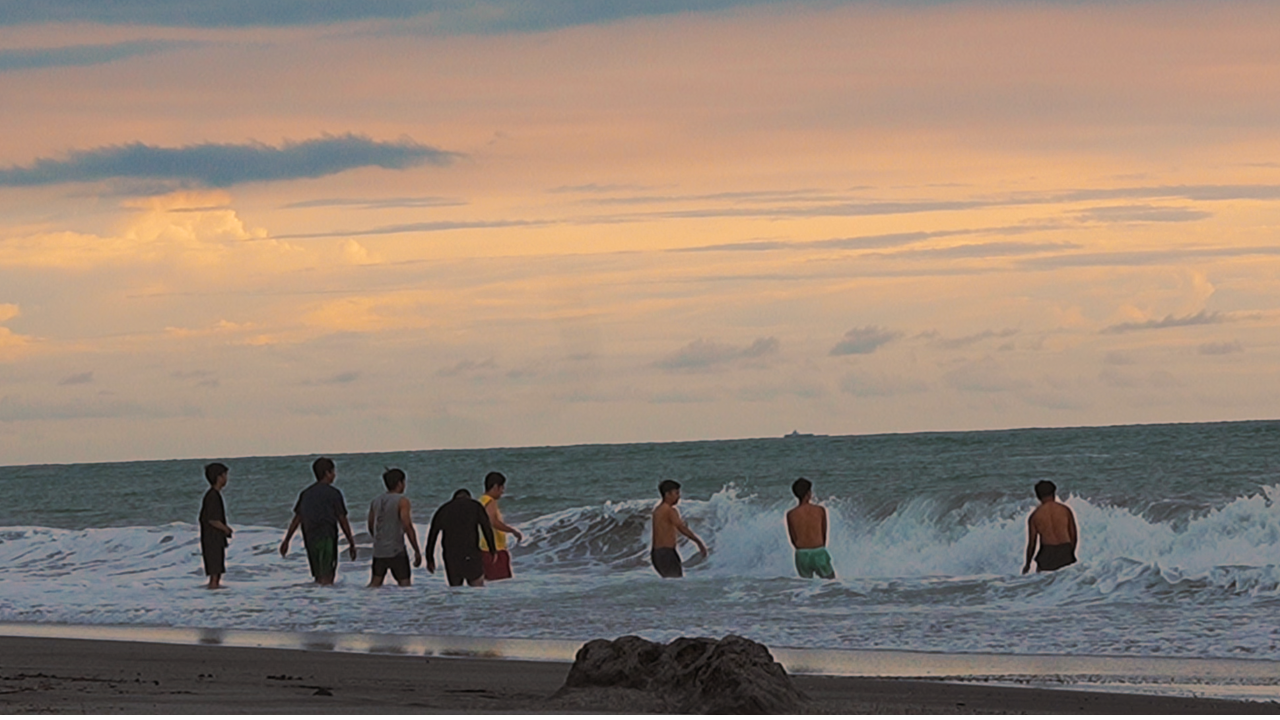
We’ve been trained to think paradise has to be white. Powder-fine, bleach-bright, the kind of sand that photographs well before you’ve even unpacked. Zambales doesn’t have that sand. It has grey — heavy, mineral-dark, pulverized rock that Mount Pinatubo blew across Central Luzon in 1991 and the tide has spent thirty-five years grinding down. Outside peak season, when the surf crowds thin out and the “Ber” months — September through December, when Philippine beach season traditionally kicks into gear — are still a stretch away, that grey is the whole point.
This isn’t a report on Zambales at peak season, when Liwliwa fills with surfboards and string lights and San Felipe’s roadside bars run past midnight. It’s what the province looks like when almost none of that is happening — and why that version might be the more honest one.
The Sand That Isn’t Supposed to Be Beautiful
Zambales’ coastline is built from lahar — the mudflow of volcanic ash and debris that swept down from Pinatubo during its 1991 eruption, one of the largest of the 20th century and still the reference point for how the province’s landscape looks and behaves today. Ash filled rivers, buried towns, and reshaped the coast; what eventually reached the sea got worked over by decades of tide until it became sand. It’s not the postcard kind. It’s dense enough to hold heat well after sunset, dark enough that it absorbs light instead of throwing it back at a camera, and it carries a texture — coarser, heavier underfoot — that white sand simply doesn’t have.
That density is easy to read as a flaw if you’re expecting Boracay. It’s harder to dismiss once you register what it actually is: ash, reclaimed by the tide, sitting under your feet as the literal residue of a disaster the region built itself back from. The “Black Beautiful” framing isn’t just an aesthetic reframe — it’s an accurate one. This coast rose from something. White sand, mostly, didn’t have to.

Liwliwa Without the Surf Season
Liwliwa, San Felipe’s best-known stretch, runs on a different rhythm outside the Ber months. In peak season it’s Zambales’ answer to a surf town — swell chasers, ATV rentals on the sand, bonfires that run late. Off-season, the huts built from Agoho wood are still there and the gravel paths still run between them, but the crowd chasing a wave is gone. What’s left is a slower, steadier version of the same place: a beach stroll without a schedule attached to it, coffee from a roadside shack that stays open whether or not anyone’s surfing that week.
That’s not a lesser version of Liwliwa. It’s arguably the more sustainable one — and the shop owners and stall vendors who keep serving coffee through the quiet months, without a tourism campaign propping them up, are the actual reason the town survives to have a peak season at all.
Botolan, Where the Road Runs Out
North of San Felipe, the coast gets rawer. In Botolan, the river meets the sea in a wide, mostly empty breach, and there’s no curated itinerary waiting for you — no tour guide narrating the view, no signage cueing up a photo spot. It’s closer to standing at the edge of something than visiting a destination. The trade-off for that rawness is scale: no crowds, no built-up frontage, just the size of the coastline and however long you’re willing to sit with it.
The contrast between San Felipe’s surf-town infrastructure and Botolan’s emptiness, twenty-some kilometers apart, is really the province in miniature — Zambales holds both a built-out beach scene and land that’s barely been touched, without needing to choose between them.

The Sound of a Coast That Doesn’t Perform
There’s a version of beach travel that’s mostly visual — the shot you came for, the sunset you needed for the feed. Zambales pushes back on that a little, because so much of what makes the Botolan stretch in particular worth the trip isn’t what it looks like. It’s what it sounds like. The West Philippine Sea hitting mineral-heavy sand doesn’t sound like the hush of waves on fine white grains; it’s deeper, more percussive, closer to a gravelly pull than a lap. Nothing about it is designed to be pretty. It’s just the sound of tide moving over ash that used to be a mountain, and there’s something clarifying about standing in front of a landscape that isn’t trying to earn your attention.
By evening, the grey sand shifts too — toward a bruised, deep purple as the light drops, a reminder that this coastline is still actively changing, still being worked over by weather and tide regardless of who’s there to watch it happen. It’s not staged for a hashtag. It was doing this before any of us showed up, and it’ll keep doing it after.
The Economics of Staying Quiet
The case for Zambales isn’t just aesthetic — it’s financial. Peace, the kind that usually gets sold as a multi-island, multi-transfer trip to somewhere in the Visayas or Palawan, is a few hours up the road from Manila here, at a fraction of the cost. You don’t need a month’s salary or three flight connections to get somewhere quiet. You need a bus ticket and roughly half a day.
That accessibility matters more in the off-season than in it. Tourism data tends to reward the places already getting attention; the quiet months are where a destination’s actual resilience shows — whether the local economy holds up without a campaign behind it, on the strength of the people who keep showing up anyway.
There’s a broader point buried in that, too. We tend to talk about “world-class” as something that has to be imported — validated by international attention before it counts as worth visiting. Zambales doesn’t have that validation right now, and it doesn’t especially need it. The people actually sustaining these towns aren’t foreign tourists chasing a bucket-list stamp; they’re weekend travelers from Manila, sharing a meal by a bonfire or walking the shore on an off-season Saturday, treating a quiet Tuesday in San Felipe like it’s worth the trip on its own terms. That’s a different kind of premium than the one usually being sold — not a place validated by scarcity or distance, but one that’s simply there, close enough to visit without waiting for permission from anyone else’s itinerary.
Field Notes
Getting there: Take a Victory Liner bus from Cubao or Pasay toward Zambales (via Iba or Olongapo) and tell the conductor you’re getting off at San Felipe — the drop-off is by the 7-Eleven across from the San Felipe Public Market. Travel time runs 3–5 hours depending on traffic. From the 7-Eleven, tricycles to Liwliwa are staged right beside it; just tell the driver which resort you’re headed to.
Getting around Botolan: Botolan is roughly 20–25 minutes north of San Felipe by tricycle or habal-habal (motorcycle taxi) — arrange one from Liwliwa or San Felipe town proper, since there’s little transport infrastructure once you’re there.
Where to eat/drink: Roadside coffee shacks along the Liwliwa strip stay open through the off-season and are worth prioritizing over the resort cafés — they’re the ones actually keeping the local economy steady between peak seasons.
Best time to visit for this version of Zambales: Outside the “Ber” months (September–December), when the surf crowds and swell-chasing traffic thin out. Off-season stretches also mean lower accommodation rates.
Budget (per person, PHP)
- Bus fare, Manila to San Felipe (Victory Liner, one-way): ₱500–600
- Tricycle, San Felipe to Liwliwa: ₱40–100 depending on the driver and drop-off point
- Habal-habal/tricycle, Liwliwa to Botolan: ₱150–250 round trip, negotiable
- Accommodation (budget hut/room, per night): ₱800–2,000
- Meals (roadside/local, per day): ₱300–500
- Kitchen fee if self-catering (per stay, resort-dependent): ₱500
We shot the footage behind this piece earlier this year, on one of the quieter stretches of the off-season calendar. If you want the visual feel of the grey sand and the empty Botolan breach described above, the video’s still up here.