
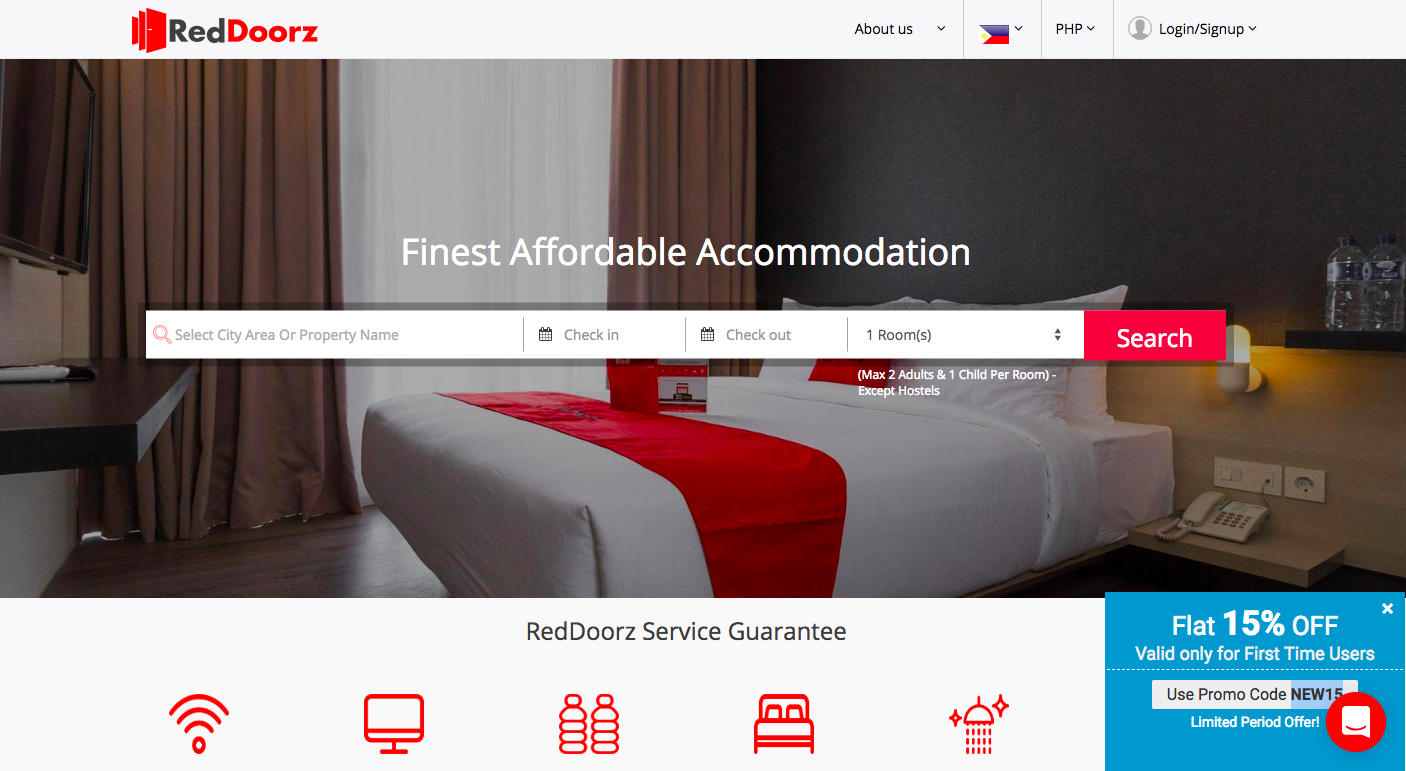
RedDoorz, one of the leading online budget hotel booking platforms in Southeast Asia, has announced its expansion into the Philippines — its third market in the region after Indonesia and Singapore. The company is investing more than US$5 million into the push, with plans to grow its footprint to 100 properties across the Philippines within the next 12 months.
Founder and CEO Amit Saberwal described the move into the Philippines as a natural next step for RedDoorz, noting that the market shares many of the same characteristics that made Indonesia, its first market, such a strong fit for the brand. He explained that RedDoorz operates on a city-to-city model rather than a country-by-country one, an approach that has already grown the company to more than 500 properties, over 1 million room nights processed, and occupancy rates consistently above 80 percent across 16 Indonesian cities and Singapore — and now the Philippines.
Saberwal pointed to the Philippines’ standing as the world’s second-fastest-growing internet economy, right after Indonesia, with an internet penetration rate of 63 percent, or about 67 million users, out of roughly 105.7 million Filipinos. He said that while RedDoorz continued expanding in Indonesia, the company had also been closely watching the Filipino market, and that a fresh round of funding earlier in the year confirmed there was strong demand for hotel rooms among both tourists and business travelers. That, combined with the momentum he’s seen in the local budget hospitality sector in recent years, made this the right time to move in.
The timing is backed by the numbers. A joint study by Google and Temasek Holdings, “e-conomy SEA: Unlocking the $200B Digital Opportunity,” found that the Philippines ranks as the world’s second-fastest-growing internet market after Indonesia, with the potential to grow 11 percent annually (CAGR) to 93 million internet users by 2020. That growth is expected to carry over into online travel: the online hotel and airline booking market in the Philippines is projected to grow roughly fivefold, from US$1.1 billion in 2015 to US$4.6 billion by 2025. A separate 2018 report from WeAreSocial found that of the Philippines’ 67 million internet users, more than 60 million are active on social media through mobile, whether as unique mobile users or active mobile social users.
Alongside its Philippine launch, RedDoorz is introducing a new property category. In addition to its existing RedDoorz and RedDoorz Plus tiers, the company launched RedDoorz Premium in June 2018 — a category built for the budget business traveler, with properties located closer to business districts and offering more amenities than the brand’s other two tiers.
The broader travel numbers make the case for why RedDoorz is betting on the Philippines now. The World Travel & Tourism Council found that domestic travel spending generated more than 86 percent of the Philippines’ direct travel and tourism GDP in 2016, and is expected to grow 4.8 percent annually to ₱3,336 billion by 2027. The Philippine Statistics Authority likewise found that domestic travel rose 20 percent from 2012 figures that same year, a trend backed by the 2016 Household Survey on Domestic Visitors, which found that three out of five Filipinos 15 and older (59 percent, or close to 61 million people) traveled within the country that year. With internet penetration climbing alongside steady year-on-year growth in both domestic and international travel, RedDoorz sees budget hospitality as a key driver of the tourism sector going forward.
Chief Operating Officer Rishabh Singhi said the idea for the new Premium tier grew out of watching the Filipino “condotel” concept take off over the past decade. Adding the category, he said, let RedDoorz create a clearer distinction between room types while staying true to the standardized, predictable experience the brand promises across all its properties — all at an affordable price point. The tier specifically targets business travelers looking for amenities like reliable Wi-Fi and proximity to business districts, and Singhi expects it to be a strong category as RedDoorz expands into other Southeast Asian cities with growing business-traveler demand.
He added that RedCash, the company’s loyalty program that has proven especially popular in Indonesia, will also roll out to Filipino customers. With high mobile and social media usage among local Filipinos, Singhi said RedDoorz expects new customers to book through the RedDoorz app and redeem RedCash earned from their stays, and pointed to the company’s current repeat-stay rate of more than 80 percent as a benchmark it intends to maintain across all three markets.
RedDoorz says its entry into the Philippines is backed by a local team with deep knowledge of the country’s travel and hospitality sector, running a full operations unit in Manila that spans customer service, operations, product sales, branding, finance, and marketing. The company has also built its own proprietary data analytics technology to forecast demand in areas that could support more hotels or properties, with the goal of driving more foot traffic for travelers.
Saberwal said the company’s growth has consistently come down to building the right team, working with the right investors, and being patient for the right market opportunity — a formula he credits for RedDoorz’s success in Indonesia and its entry into the Philippines. He acknowledged that the biggest challenge remains shifting the mindset of property owners toward accepting the RedDoorz model, since the disruption technology has brought to the sector is still relatively recent, having taken hold only over the last three to four years in the region. He said RedDoorz sees itself as playing an educational role with these owners and their staff, helping them understand why moving onto online platforms matters for their business, and giving smaller and mid-sized properties access to the kind of reach normally reserved for large hotel chains — which he called the biggest beneficiaries of RedDoorz’s technology-driven approach.
Over the past 18 months, RedDoorz has trained more than 2,000 staff across its properties in Indonesia and Singapore through RedPro, its in-house training program, which covers areas including technology, housekeeping and maintenance, and sales and marketing for partner-property staff. The company now has a team of more than 180 people across four countries covering operations, sales, marketing, and other aspects of hospitality.
Headquartered in Singapore, RedDoorz recently closed a Pre-Series B round of US$11 million, with additional investment from the Asia Investment Fund of Susquehanna International Group, the International Finance Corporation (the private investment arm of the World Bank Group), InnoVen Capital (a venture lending firm owned by Temasek Holdings and United Overseas Bank), and Jungle Ventures, all of which had backed the company in earlier funding rounds. The round also brought in new investors DeepSky Capital, FengHe Group, and Hendale Capital, among others.