
Back in March, we put out a video making the case that the Philippines was losing the tourism war — billboard drama at the airports, a tourism department missing its own arrival targets two years running, the whole picture. If you haven’t seen it, it’s still up here. A lot has moved since then, so before we get back to the argument we made in that original piece, here’s the update.
The Update
A lot has moved since March. The tourism department has a new chief — Dita Angara-Mathay took over as Secretary of Tourism this past summer — and in the months since, DOT has named P-pop groups BINI and SB19 as official tourism ambassadors, launched a domestic travel-deals campaign called “Discover More to Love,” and has reportedly been eyeing Alex Eala, fresh off her first WTA Tour-level title, for that same ambassador list. That whole wave deserves its own closer look, coming soon.
None of it, though, touches the actual number this story started with: the gap between the Philippines’ international arrivals and Malaysia’s 40 million or Thailand’s 30 million. A louder ambassador roster and a domestic discount platform are genuinely smart moves, but neither is infrastructure — neither is an airport with enough capacity, a ferry system that connects to the rail, or a supply chain that can absorb a tourism surge without prices spiking against the people who live there. Worth watching whether the arrival numbers actually move, or whether this ends up being a louder version of the same gap.
Which brings us back to the actual argument from March: while the department sorts out the international side, the burden of keeping hotels, boat operators, and beach towns afloat is still mostly falling on Filipinos ourselves. If rest is now something of a domestic economic obligation, are we actually resting when we take it on — or just performing it somewhere with better lighting?
A Different Kind of Rest
That question mattered most during that April long weekend, when the traffic and the airport lines made it obvious just how many of us were trying to cram a full reset into a few short days. Watching the scale of that exodus, the thing actually worth cutting wasn’t food or a habit for a few weeks — it was the rush itself: the compulsion to perform relaxation, to pack a schedule until it looks productive even on vacation, to treat every free hour as something that needs to be spent well or not at all.
That reframe matters because the guilt cut both ways. Skip the trip and you’re not “contributing” to an industry that’s visibly struggling. Take the trip and you’re liable to over-plan it into something indistinguishable from work. Either way, the actual point of a long weekend — doing nothing in particular — gets lost.
The Optimization Trap
There’s a specific kind of exhaustion that comes from planning a vacation the way you’d plan a product launch. Fully booked resorts scouted weeks out, cafes mapped, itineraries stacked hour to hour — the same optimization instinct we apply to work, redeployed against rest. It doesn’t feel like escape. It feels like bringing the office to the beach and calling it a change of scenery.
The tourism numbers made that instinct worse, not better. When an entire industry’s survival seemed to hinge on domestic travelers showing up and spending, “just relaxing” started to feel almost irresponsible — like the vacation needed to be maximized to be worth the guilt of not going somewhere more visibly generative. That pressure was exactly backwards. A vacation that’s been scripted down to the hour isn’t a break. It’s a second job with a nicer view.

You Don’t Need a Boarding Pass
The alternative isn’t complicated, it’s just unfamiliar: staying close. A quiet hotel a few blocks from home, a neighborhood café, letting the rest of the city empty out for the long weekend without you. In Manila specifically, that meant places like Lime Resort Manila for a staycation reset, and Quan Spa at the Manila Marriott for the kind of stillness that doesn’t require a flight — a deserted spa in the middle of the metro doing the same job as a beach three provinces away.
This isn’t a case for skipping travel altogether. It’s a case for treating “stay” and “go” as equally legitimate answers to the same question, instead of treating distance as a proxy for how relaxed you’re allowed to feel. There’s a version of rebellion in booking a room a few blocks from your own apartment and letting the rest of the city clear out without you — no boarding pass required, no twelve-hour drive, just a deliberate refusal to associate peace with mileage.
If You Do Go, Go Past the Center
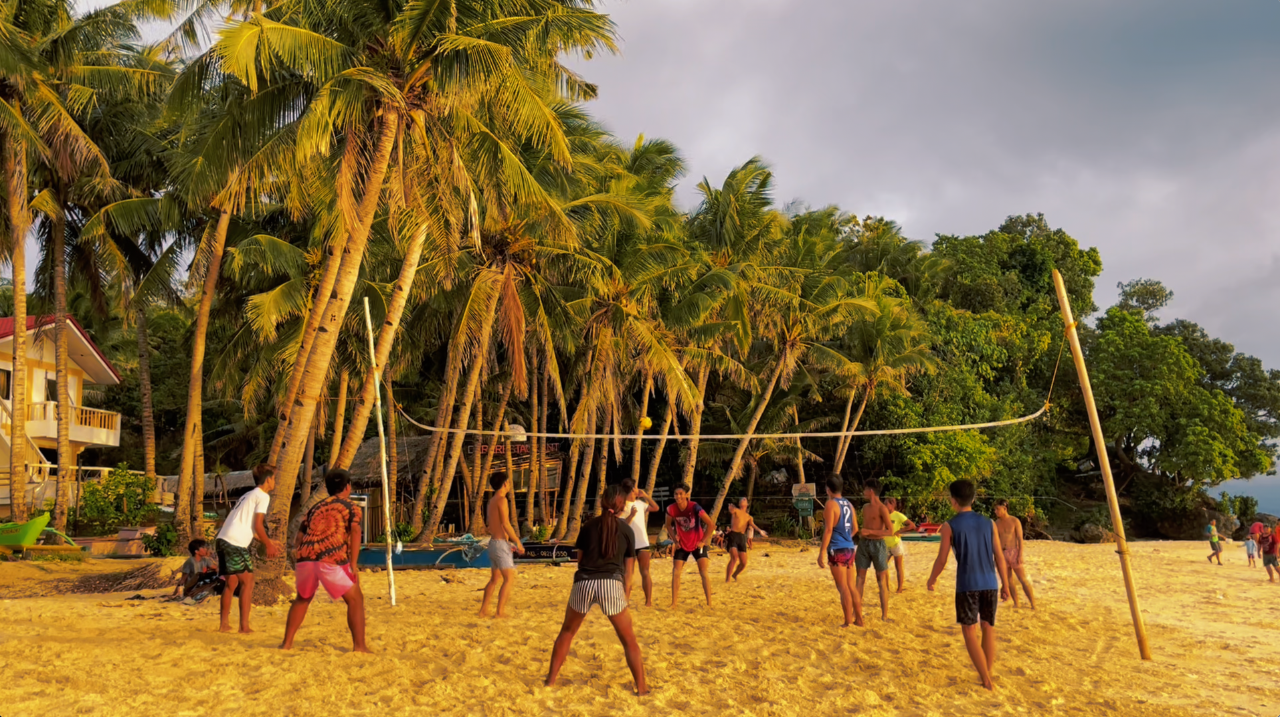
For travelers who did want the horizon, the smarter move that long weekend wasn’t the obvious one. Boracay still pulled the predictable crowds — full resorts, booked-out ferries, the itinerary-heavy version of a beach trip, the exact kind of scripted joy that long weekend seemed determined to warn against. The quieter play was pushing past it: Baler, Aurora, for surf towns that haven’t been fully absorbed into the resort circuit; the volcanic black-sand coast of Sundowners in Botolan, Zambales, for something that looks nothing like the white-sand postcard version of a Philippine beach; and Jomalig Island in Quezon Province, reachable only after a genuinely punishing boat ride that functions as its own filter — by the time you’re standing on that shoreline, nobody’s checking a schedule.
The pattern holds across all three: distance from the center doesn’t just mean fewer people, it means fewer expectations. The effort required to get there quietly strips the itinerary down to nothing, because there’s no infrastructure left to overbook, no wifi-enabled café to compare against three others on a list. What’s left is closer to what a long weekend was supposed to be before it became a logistics exercise — an ocean that doesn’t care about your schedule, and a wind that isn’t asking for your productivity. It’s also, not for nothing, exactly the kind of trip “Discover More to Love” says it wants to encourage — which makes it a reasonable place to actually check the campaign’s deals platform before you book.
The anxiety underneath all of this, the one driving both the over-optimized itineraries and the guilt about not traveling far enough, is really just the fear of being left behind — by the industry’s numbers, by everyone else’s highlight reel, by the sense that everyone else is doing rest correctly and you’re the only one still checking your phone. The honest answer is that the choice of where to go, or whether to go anywhere, was never actually about the destination. It was about whether you gave yourself permission to stop producing for a few days, wherever you happened to be standing when you did it.
Field Notes
Lime Resort Manila — city staycation option; good for travelers who want a full reset without leaving Metro Manila. Book ahead for long-weekend dates, as domestic staycation demand spikes hard around major holidays.
Quan Spa, Manila Marriott Hotel — spa access within the Marriott property; ideal as a half-day or single-treatment stillness break rather than a full staycation.
Baler, Aurora — reachable by public bus or private van from Manila (roughly 5–6 hours); known for surf culture and a slower pace than the bigger beach towns.
Sundowners, Botolan, Zambales — roughly 3–4 hours from Metro Manila by car; volcanic black-sand coastline, best visited outside peak midday sun.
Jomalig Island, Quezon Province — accessed via a multi-hour boat ride from mainland Quezon (departure points and schedules are weather-dependent and irregular, so build in flexible days). Limited accommodations on-island — arrange lodging before departure, not on arrival.
Worth checking before you book: the DOT’s “Discover More to Love” deals platform (tourism.gov.ph) runs through November 2026 and covers hotels, airlines, and booking platforms nationwide — worth a look for any of the routes above.
Budget
Costs vary widely by season and how far in advance you book, but as a rough range for a long-weekend trip:
- City staycation (Lime Resort Manila, 1–2 nights): ₱4,000–₱8,000
- Spa treatment (Quan Spa, single session): ₱2,500–₱5,000
- Baler round trip (bus/van transport + 2 nights budget lodging): ₱4,000–₱7,000
- Zambales day trip or overnight (transport + lodging): ₱3,000–₱6,000
- Jomalig (boat fare + basic lodging, multi-day): ₱5,000–₱9,000
Boracay, for comparison, typically runs well above these ranges during peak holiday weekends given resort pricing and ferry demand.
This piece is the companion read to the video it’s drawn from, shot earlier this year around the trip described above. For the full visual walkthrough of the tourism data, the billboard fallout, and the shoreline footage from Zambales and Jomalig, the video’s still up here.
Pingback: New Direct Flights to Manila: Riyadh Air, Air India, and the Routes Coming in 2027 | ELYSPLANET
Pingback: The DOT Wants to Stop Counting Tourists. Its New Target Is Investment. | ELYSPLANET
Pingback: Cebu Pacific’s New Routes: Shanghai, Nagoya, Xiamen, Hanoi and Ho Chi Minh City by November 23 | ELYSPLANET